
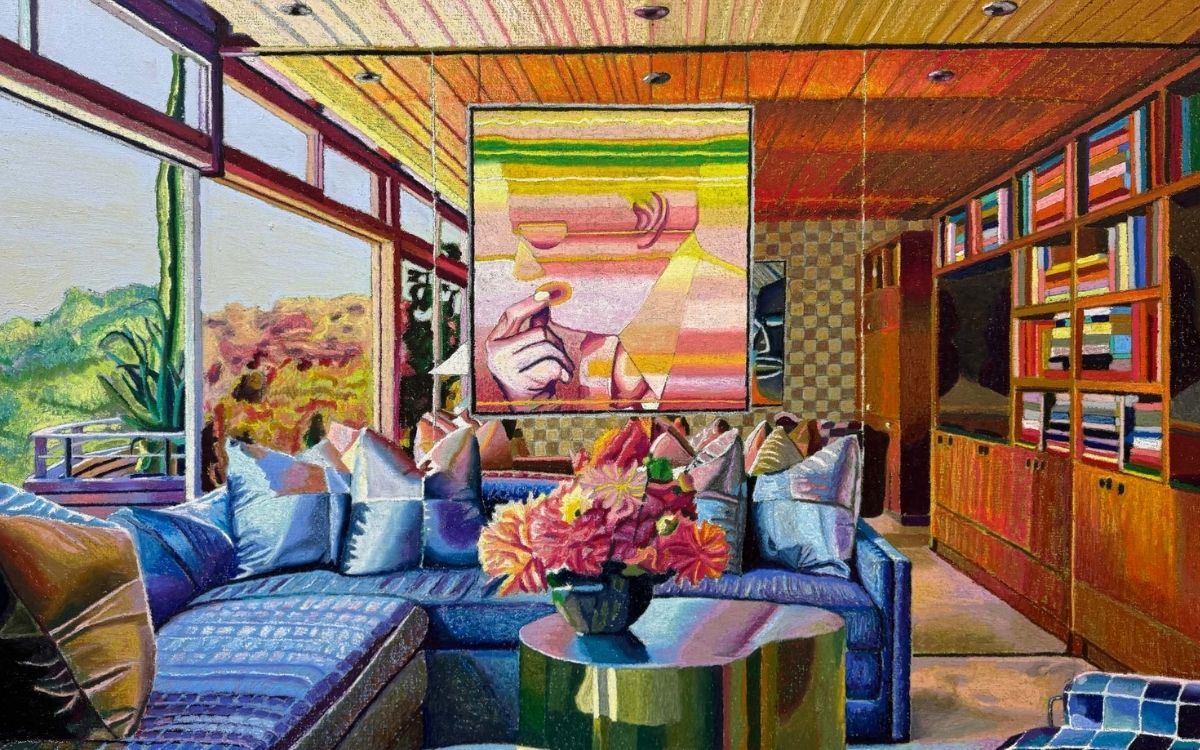
JJ Manford paints environments that satisfy materially and visually while leaving room for the viewer to bring their own experience. Not ambiguous, not didactic, not organised around a message that needs to be decoded: the question driving the work has always been one of presence. Working across a practice that has shifted repeatedly over the years while arriving, in the last seven, at what feels like a genuine synthesis, Manford has found in colour the key that unlocked everything. Teaching a college course in colour about a decade ago changed the way the world looks, and the paintings since then have carried that transformation: process and content held in equal weight, the way a thing is made inseparable from what it depicts.
✧✧✧
How do you reconcile the tension between raw, innate creativity and the discipline required to master your craft?
You can start with raw, innate creative impulses, & if the impulses are great enough, you will master your craft on your own terms, over time. It seems to happen unconsciously, without me even trying. If the innate creative impulse were not great enough, I may not have found enough sustenance to facilitate discipline.
Have you ever felt drawn toward a conventional career path? What made you take the "creative leap" despite the risks?
I taught for several years. I think most artists will tell you that they balance their studio time with a part-time or full-time job. I only became a full-time artist when I could sustain myself financially, so actually it was a calculated risk. That being said, I never seriously considered pursuing any other career path other than artist and teacher.
How do you reignite creativity during those inevitable periods of self-doubt or stagnation?
I push through, despite the difficulty, because I know from experience that these feelings are not permanent.
Do you believe an artist's passion is something destined or a conscious choice?
I believe that a combination of circumstances determine an artist's passion. There are genetics, ie their nature, and then there is their environment, ie how they were raised (what value was art given in their household, for example), what opportunities they had, and whether or not they received the right kind of positive reinforcement as young people. I do believe there is such a thing as innate talent, but it will remain innert or be squandered if the right circumstances are not in place.
What do you think is the most meaningful role an artist plays in society today?
The role an artist plays cannot be generalized, and I certainly do not think they need an agenda. Some artists will create meaning by making objects and images of aesthetic beauty, which is as important to our well-being and prosperity as anything else. Others will try to take on the government, or bring awareness to an environmental or social issue, in order to actively bring about some sort of awareness and eventual change. Whatever they do, they will do it freely, and will inevitably have people wishing they too could make art.
How important is it for viewers to understand the intended message of your work? Does ambiguity add value, or do you seek clarity in your expression?
I do not have anything in my work that I would consider my "intended message"; as a matter of fact, I tend to gravitate away from work that is didactic and contains an idea that I need to understand in order to properly experience it. I do not make ambiguous work, either. The question for me is not one of ambiguity vs. specific intent, but one of presence: have I created a rich, provocative environment that satisfies materially and visually, while leaving room for the viewer to project their own experience(s) onto the work?
Have you ever struggled with the ethics of your art—such as who it represents or who it impacts?
I believe so, yes. Ever since I started incorporating architecture and specific objects in my paintings, I have also been projecting signifiers of class, even though my primary interest has remained aesthetic. Some of my paintings depict kitsch objects or low-brow pop commodities, in contrast to high-end furnishings and environments. The struggle stems from the fact that, while I can acknowledge that class distinctions are being made, from time to time, I am not interested in that conversation and continue to paint objects and environments that I am drawn to for their beauty.
How has your artistic style transformed over the years? Are there specific influences, experiments, or moments that marked a turning point?
My artistic style has transformed so many times in my lifetime; however, it has remained more or less the same (though I would like to think it has evolved) over the last seven years. More than subject matter or image, process has long motivated me the most to make art; to put it simply, historically I have been more interested in how my paintings are made than in what they are depicting, and the studio has been a laboratory for material experimentation and idiosyncratic approaches over the years. Nowadays, I have achieved a synthesis where the content (ie imagery) is of equal interest to me as the way the work is made. In many ways, my current work feels like a culmination of everything that came before it. Arguably the biggest force that has enabled this synthesis is my study of color; about ten years ago, I started teaching a college course in color, and this changed the way I see the world.
How do you think art should be valued—emotionally, socially, or monetarily? Is there ever an objective measure?
Why must this be a choice between values, when all are true? I cannot speak to the objectivity of it all, but time seems to be a great indicator of what is great and what is not as good.
How do you approach criticism, whether from peers, critics, or audiences?
I take all criticism to heart. Typically, it matters to me from whom the criticism comes, and this plays a factor in my reaction to it. Criticism is an amazing opportunity to step outside yourself and see what others see, that you cannot-because you are too close to the work—or to confirm a notion you felt but did not want to admit was true.
Is art created for the artist, the audience, or somewhere in between?
That is up for each individual artist to determine. That being said, once art is created, or perhaps before it is even created, it has an autonomy beyond the artist's control, assuming it is made public.
Do you think art that is created for commercial success loses its integrity, or can it still hold meaning?
It still holds meaning. I do not think you can objectively measure something like that; most art is motivated by commercial success, but that does not have to denigrate its meaning, nor is it necessarily a conflict.
✦ ✦ ✦
JJ Manford pushes through self-doubt because experience has confirmed that such feelings are not permanent. The studio has long been a laboratory, the process historically more interesting than the subject, and yet the work now achieves something that feels like a culmination: kitsch objects alongside high-end environments, beauty pursued without apology, and an honest acknowledgment that class signifiers appear in the paintings even when that conversation is not the one being sought. A show with Derek Eller Gallery in January 2027 is on the horizon. The longer aspiration, a museum show, remains in view. And the work, once made public, has an autonomy beyond any single artist's control. That autonomy, trusted and welcomed, is exactly where Manford seems most comfortable leaving it.