
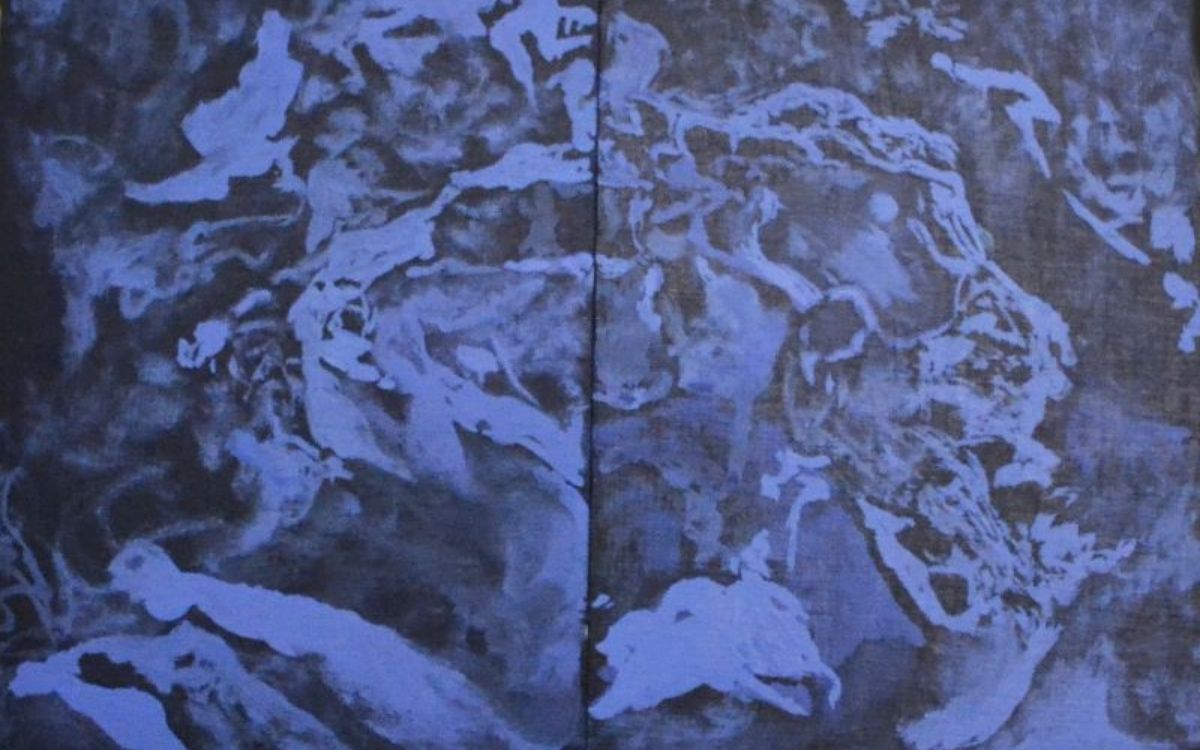
Lila Boutari stitches canvases together by hand before a single brushstroke is applied, treating the construction of a surface as inseparable from its meaning. Working across painting and textile practice, Boutari draws on a recurring subject, rock formations photographed along the same shoreline each summer, to explore erosion, transformation, and the way both stone and people are quietly reshaped by what they are exposed to over time. Visible seams are left on purpose. Discarded canvas offcuts are given new purpose. Nothing is concealed that does not need to be. What follows is a conversation about process, ambiguity, and the value of periods that look like stagnation but are quietly generative.
How do you reignite creativity during those inevitable periods of self-doubt or stagnation?
Every artist, at some point, encounters an inevitable period of creative drought or stagnation within their practice. In my opinion, this is not only natural but an essential part of any sustained creativity. Rather than viewing these periods as failures or interruptions, I have come to understand them as necessary phases of incubation moments when the mind quietly gathers the raw material for what comes next.
What I have come to appreciate most about these periods is the space they create. When the pressure to produce finished work temporarily lifts, I find myself with room to explore ideas, materials, and mediums I might have never otherwise considered. There is a kind of luxury in this uncertainty: it grants permission to experiment without the immediate expectation of a polished result. Looking back, I recognize that these periods of apparent stagnation have often been the most generative parts of my process, even though their value only becomes clear in retrospect. It is only after emerging on the other side of an artistic block that I fully appreciate the privilege of having had that time to wander, question, and rebuild.
This understanding has become especially clear to me in my recent work. During periods of self-doubt or creative pause, I have found myself drawn to building new foundations for future pieces literally and conceptually. What I mean by this is that I create new structural bases for my work by hand-stitching together panels of canvas, forming patterns through the careful joining of individual pieces. This process has become both a technical foundation and a meditative practice, one that allows me to remain connected to my work even when I am not actively producing a finished piece.
How important is it for viewers to understand the intended message of your work? Does ambiguity add value, or do you seek clarity in your expression?
I do not believe it is necessary, or even particularly desirable, for a viewer to arrive at a single, intended understanding of my work. Ambiguity is not a shortcoming to be resolved; rather, it is one of the most valuable qualities a piece can hold. I have never subscribed to the idea that a single artwork should carry only one meaning. Both as a person and as a creative practitioner, I welcome multiple, even conflicting, interpretations of what I make. Art, in my view, is not a message to be decoded but an open space to be entered, and each viewer brings their own history, perspective, and sensibility into that space.
For this reason, I have never actively asked for clarity in the traditional sense. In my experience, no person thinks the exact way another does in exactly the same way, and each individual approaches a given piece of work through a distinct lens shaped by their own experiences, values, and ways of seeing the world. What one viewer reads as tension, another may read as harmony; what one interprets as sorrow, another may interpret as restraint. Rather than viewing this variability as a communication failure on my part, I see it as evidence that the work is doing exactly what I hope it will do: inviting genuine engagement rather than passive reception. A piece that produces only one fixed interpretation across every viewer would, to me, feel closed rather than alive.
This openness to multiple readings is not a lack of intention on my part, but a deliberate embrace of interpretive freedom. I am far more interested in creating a foundation from which many meanings can emerge than in constructing a single narrative that viewers are expected to uncover correctly. In this sense, ambiguity functions as an invitation rather than an obstacle. It allows the viewer to become an active participant in the meaning making process, rather than a passive recipient of a predetermined message. I would argue that this kind of openness ultimately deepens engagement with the work, since viewers are encouraged to bring their own perspective to bear rather than search for a single “correct” answer.
That said, there has been one occasion when a viewer’s response to my work did genuinely give me pause. A few months ago, someone described my work as generic. When they noticed that I did not respond warmly to this characterization, they attempted to soften the remark by rephrasing it as “generative” instead. While I understand the comment may have been an attempt at diplomacy, the exchange stayed with me, largely because it highlighted an important distinction between ambiguity and a perceived lack of originality. Ambiguity, as I understand and practice it, is an intentional openness to multiple meanings; it is not the same as producing work that feels interchangeable or derivative. That single interaction made me more conscious of the difference between inviting varied interpretation and being perceived as lacking a distinct artistic voice, and it has since encouraged me to reflect more critically on how I articulate the intention behind my ambiguity, even as I continue to resist prescribing any single meaning to the viewer.
Ultimately, I see my work as a starting point for dialogue rather than a fixed statement to be understood in only one way. I am far less concerned with whether a viewer arrives at the “correct” interpretation than with whether the work succeeds in prompting genuine thought, reflection, or emotional response. In leaving space for multiple readings, I hope to create work that remains open and generative over time, rather than work that is exhausted the moment its singular meaning is identified. This openness, I believe, is not a retreat from artistic intention, but an expression of trust in the viewer’s own capacity to engage meaningfully with what they see.
Can you take us through the evolution of an artwork, from that first spark of inspiration to the finished piece?
Over the past several years, I have been developing an ongoing body of work titled the Rock Formation Series, drawn from a specific and deeply personal source: the rocks along the shoreline near my summer house. Each summer, I return to this same stretch of coastline to photograph these rock formations, building an evolving visual archive that traces their transformation over time. Through this work, I explore how these formations have gradually changed, worn and reshaped by the persistent action of saltwater against their surfaces. What began as a simple documentary impulse has grown into a broader meditation on change, erosion, and the passage of time.
At the core of this series is a question that extends well beyond geology: how does nature transform across time in ways that parallel the human experience? Just as the rocks are slowly reshaped by exposure to the elements, people, too, are altered by the forces they encounter over the course of their lives. Central to this inquiry is the idea that once something breaks or changes, it can never fully return to its original form. There is no reversal, only adaptation. The rock formations in these photographs are not simply eroding; they are becoming something new, carrying the marks of that erosion as part of their present identity, much like the way personal experiences leave lasting impressions on who we become.
While photography forms the foundation of my research process, my paintings are not intended as literal reproductions of these images. Instead, I use the photographs as a starting point, drawing on my own visual memory and imagination to reinterpret the forms. I intentionally depart from strict realism, allowing intuition and invention to guide the translation from photographic reference to painted surface. This approach allows the work to exist somewhere between documentation and imagination, between what is observed and what is felt.
Before any painting begins, however, I engage in an equally important preparatory process that I have mentioned previously: constructing the physical foundation of each piece by hand stitching individual canvas panels together to form larger, patterned compositions. This panel construction is not merely a technical or structural necessity but an integral part of my artistic language. Within this stitching process, I deliberately allow certain seams to remain visible on the front, or “outer,” surface of the piece, rather than concealing them entirely on the reverse side as is conventional. Some viewers may interpret these exposed seams as imperfections or irregularities in the surface. I see them differently. Rather than framing them as flaws to be minimized, I consider them a visible record of difference and variation, echoing the very themes of transformation and change that run throughout this series. Just as the rocks bear the visible marks of their own gradual reshaping, the canvases carry the marks of their construction, refusing to hide the process that brought them into being.
In this way, the physical structure of each piece becomes inseparable from its conceptual meaning. The visible stitching does not simply support the painted surface; it actively participates in the work’s central themes of erosion, adaptation, and the passage of time. The panels, pieced together by hand, mirror the fragmented and reassembled nature of the rock formations themselves; formations that have been broken down and reshaped by their environment over years of exposure, yet remain whole in their own right.
Ultimately, the Rock Formation Series is as much about process as it is about subject matter. It reflects my ongoing interest in how both natural and human forms are continuously altered by time, environment, and experience, and how the marks of that transformation, whether etched into stone or stitched into canvas, become part of a new and evolving identity. Rather than seeking to disguise these traces of change, I choose to foreground them, treating each visible seam and each reshaped form not as a departure from wholeness, but as evidence of a continuous and ongoing process of becoming.
Can art be truly therapeutic? Have you experienced its healing power personally, or seen it impact others?
Art functions as a form of therapy within my practice, offering a space in which the pressures and distractions of daily life fall away. Regardless of how I am feeling on a given day, the moment I enter the studio and begin to work, I find myself absorbed entirely in the process. The passage of time becomes difficult to track, external concerns recede into the background, and what remains is simply myself and the painting in front of me. This state of total immersion is, for me, one of the most valuable aspects of making art: it offers not an escape from emotion, but a direct and unmediated way of moving through it.
What I find particularly compelling is the way that different emotional states give rise to distinctly different qualities within the work itself. Rather than producing a uniform or predictable outcome regardless of my internal state, each emotional condition seems to shape the painting in its own way, influencing gesture, rhythm, colour, and intensity. In this sense, my emotional life becomes an active collaborator in the creative process, rather than something separate from it. The studio becomes a place where feeling and material meet, and where the resulting artwork carries a trace of whatever internal experience shaped its making.
This dynamic became especially clear to me following the passing of my grandfather last year. In the wake of that loss, I returned to a piece I had previously set aside, one I had been hesitant to continue, uncertain of my own ability to see it through. Rather than avoiding the painting or waiting until I felt more emotionally settled, I chose to work through my grief directly within it. I allowed the sadness I was carrying to inform every decision I made on the canvas, using the act of painting as a means of processing what I could not fully articulate in words. In doing so, I was able to release a great deal of what I was holding onto internally, translating grief into a physical and visual language rather than allowing it to remain unexpressed.
Do you believe artists have a responsibility to address climate change or environmental concerns in their work? Why or why not?
I believe that artists today carry a responsibility, in some form, to engage with climate change and broader environmental concerns within their practice. This feels especially true for those of us whose work is nature rather than in figurative subject matter, given that the visible effects of climate change have become increasingly present and difficult to ignore. As artists who draw directly from landscape, material, and natural processes, we are uniquely positioned to reflect, respond to, and raise awareness of these changes through our work.
This conviction is not merely conceptual for me; it has directly shaped my material practice. My use of panel construction, now a defining feature of nearly all of my work, originated out of necessity during the Covid-19 pandemic, when access to art supplies became severely limited. At the time, I was living in the Wimbledon area, and the art supply shops I would normally rely on were closed, leaving me without a straightforward way to source new canvas. Rather than allowing this constraint to halt my practice, I turned to canvas fragments I already had on hand, offcuts and remnants that had been set aside from previous work. By hand-stitching these existing pieces together, I was able to construct new surfaces on which to paint, effectively giving discarded material a renewed purpose. What began as a practical solution to a material shortage evolved into a defining technique within my practice, one rooted in the principle of up-cycling rather than consuming new resources. In this sense, the panels that now form the foundation of much of my work carry an environmental ethic within their very construction, transforming what might otherwise have been waste into the structural basis of new artwork.
What are five steps you’re taking to ensure your continual growth as an artist?
Ensuring continual growth as an artist is not something that can be reduced to a single formula or fixed method; growth, by nature, tends to be gradual, non-linear, and often difficult to measure in the moment. That said, when reflecting on my own practice, I can identify five recurring habits and commitments that have played a meaningful role in supporting my ongoing development as an artist.
The first is maintaining a heightened awareness of my surroundings. I try to remain attentive to the world around me, whether that involves the natural landscape, everyday objects, or subtle shifts in light, texture, and form. This ongoing awareness ensures that I am constantly gathering visual and conceptual material, even when I am not actively working in the studio, allowing inspiration to emerge from unexpected and often overlooked sources.
The second is documentation. I make a consistent effort to record ideas on my iPad or in my sketchbook as they arise, whether through sketches, photographs, or written notes, rather than relying on memory alone. Creative insight often appears unpredictably, and capturing it in the moment ensures that potentially valuable ideas are not lost, but instead preserved for further development and future reference.
The third involves actively engaging with the work of other artists, particularly through visiting exhibitions whenever possible. Exposure to the practices, techniques, and conceptual approaches of others plays an important role in expanding my own artistic vocabulary. Seeing how other artists interpret material, form, and subject matter encourages me to reconsider and refine my own methods, and helps prevent my work from becoming insular or repetitive.
The fourth is maintaining a consistent studio presence, even on days when I do not feel particularly inspired or creatively energized. I have come to understand that creativity does not always arrive on demand, and that showing up to the studio regardless of my emotional or creative state is essential to sustaining long-term growth. Some of my most valuable breakthroughs have occurred not during moments of obvious inspiration, but through the discipline of continuing to work even when motivation felt absent.
The fifth is a daily commitment to stitching, which has become a foundational and almost meditative part of my practice. Regardless of where I am in the development of a larger piece, I try to engage in some form of hand-stitching every day. This consistent, repetitive process not only contributes directly to the physical construction of my work, but also helps me maintain a continuous connection to my practice, ensuring that creative momentum is never entirely lost, even during periods of uncertainty or self-doubt.
If you could step back into any artistic era, which would it be and why?
If I could step back into any artistic era, I would choose Arte Povera, the movement that emerged in Italy during the late 1960s, defined by its rejection of traditional, precious materials in favor of humble, everyday, and often discarded ones. This period resonates with me on both a conceptual and material level, and I believe my own practice already shares many of its underlying values, even without having consciously set out to align with the movement.
At its core, Arte Povera was a response against the commercialization and polish of the art world at the time, favoring instead materials such as fabric, rope, soil, and found objects, elements that were considered “poor” or unremarkable, but which artists transformed into work rich with meaning and physical presence. This philosophy strongly mirrors my own approach to materials. My use of hand-stitched canvas panels, many constructed from offcuts and remnants rather than fresh material, and more recently my up-cycling of my father’s 25 pairs of worn 501s and 511s jeans from the 90’s and 80’s into new panel constructions, reflects the same spirit of finding value and possibility in materials that might otherwise be overlooked or discarded. Stepping into this era would allow me to exist within a community of artists who shared this same instinct: to see potential in imperfection, and meaning in the overlooked.
Beyond material choice, Arte Povera also placed significant emphasis on process, transformation, and the passage of time, themes that run throughout my own work. Much like the artists of this movement, who often left visible traces of their process rather than concealing them, I choose to leave certain stitched seams exposed on the surface of my paintings rather than hidden on the reverse side. This decision reflects a shared belief that the marks of a work’s construction are not flaws to be minimized, but essential parts of its meaning, evidence of transformation, labor, and time. Being immersed in this era firsthand would allow me to engage directly with artists who were grappling with these same questions, at a moment when these ideas were still new and radical, rather than encountering them only through historical retrospect.
I am also drawn to the way Arte Povera artists engaged with nature and organic material, often incorporating raw, unrefined elements directly into their work. Given my own ongoing interest in erosion, transformation, and the way natural forms change over time, as explored in my Rock Formation Series, I feel a natural kinship with this aspect of the movement. Stepping into this era would offer the opportunity to explore these shared themes alongside artists who were actively defining what it meant to work with, rather than against, raw and unrefined materials.
What are your long-term aspirations as an artist, both personally and professionally
Professionally, I am eager to continue developing my technical and conceptual range by working confidently across multiple scales and mediums. While much of my current practice centers on hand-stitched canvas panels and painted surfaces, I am increasingly interested in extending these same principles, transformation, process, and the value of humble or overlooked materials, into three-dimensional and sculptural work. I see sculpture as a natural extension of the panel construction I already engage in, offering an opportunity to explore physical space, weight, and structure in ways that remain closely tied to my existing material language. Working across both large and small scales also feels essential to this next stage of my development, as each scale demands a different relationship between body, material, and viewer. Large-scale work allows for a kind of immersive, physical engagement, while smaller, more intimate pieces invite closer, quieter attention. I hope to move fluidly between these registers, allowing the scale of each piece to be dictated by its conceptual needs rather than by convention or habit.
Central to all of this is my continued interest in exploring the hidden parts of my own psyche, the emotions, memories, and instincts that are not always immediately visible or articulate, even to myself. Much like the exposed seams in my stitched panels, which reveal rather than conceal the process behind a piece, I hope my future work will continue to make visible what might otherwise remain hidden, translating internal, often unspoken experience into physical, material form. I do not see this exploration as something that will ever be fully resolved or completed; rather, I understand it as an ongoing dialogue between self and material, one that will continue to shift and deepen as I grow both as a person and as an artist.
Ultimately, my long-term aspiration is not to arrive at a fixed artistic identity, but to remain in continuous dialogue with my own evolving voice, allowing my practice to grow, shift, and expand alongside my personal understanding of myself. Whether working in paint or sculpture, at an intimate or monumental scale, I hope to continue creating work that reflects genuine psychological and emotional exploration, rather than work shaped primarily by external expectation. In this way, I see my personal and professional aspirations as fundamentally intertwined: the more deeply I come to understand myself through my practice, the more authentic and resonant I believe my artistic voice will become.
What distinguishes Lila Boutari's practice is a consistency of conviction running from the smallest decision to the largest. The choice to leave seams visible, to stitch remnants rather than buy new canvas, to return to the same rocks year after year, none of it is incidental. Each decision participates in the same central argument: that transformation leaves marks, and those marks deserve to be seen rather than smoothed over. Boutari is moving toward sculpture, toward larger scales, toward a deeper excavation of internal experience through material form. The aspiration, as stated here, is not a fixed artistic identity but a practice that keeps growing alongside the person making it, honest, open, and never quite finished.