
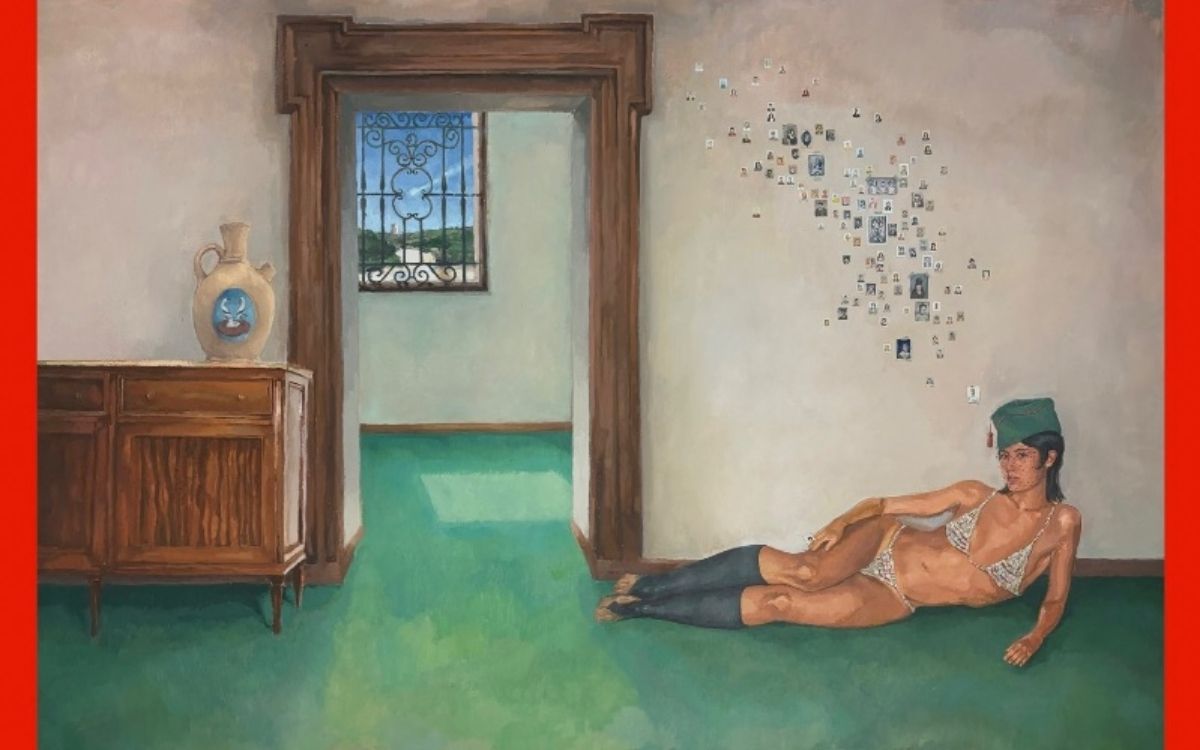
Rafael Gómez González builds worlds from accumulated devotion. The practice is rooted in collecting, not just objects but icons, symbols, and imagery gathered across a lifetime and reassembled into something coherent and personal. Folklore, religious iconography, pop culture, and the esoteric are not separate territories here but overlapping fields that feed into a single obsessive project: the re-signification of the sacred in contemporary life. What follows is a conversation about how a visual language is built from the ground up, what it protects against, and why the smallest canvas is sometimes the most honest one.
List five core themes or messages you aim to convey though your art.
My work is driven by constant exploration of identity, symbolism, folklore and a connection between the sacred, profane and pop connections. It is kind of a symbiotic relationship born from my personal passionate interests.
In a world where the sacred, the profane, and pop culture intertwine and coexist, my artwork emerges seeking to explore and re-signify the language of religious imagery. It encourages the reflection on the divine, the spiritual and the esoteric, adapting them to my earthliest vision. Through the treatment of iconography, religious narratives, spirituality, and symbolism, my art delves into the fascinating dialogue between painting, space, memory and the ideas that emerge around the act of creating.
My aim is to endow my work with an innovative approach that proposes a form of religion that distances itself from traditional structures of beliefs, doctrines, and institutions, inviting participants to explore a more intimate and free spirituality. By dispensing, to a certain extent, with established conventions, my art’s main target is to open a space where the esoteric and the everyday may meet, allowing art to become a vehicle for connection and reflection on our existence and on the meaning we assign to it; living while controlling our own narrative through its idealization from a romantic perspective, as well as of everything surrounding us. Every brushstroke and every symbol bring us closer to a deeper understanding of what the sacred means in contemporary life.
Demystifying the image of a god implies understanding that, rather than seeing gods as a distant and powerful figure, we can recognize that divinity’s essence and power reside within each of us. This perspective invites us to question why we constantly require someone to guide and protect us, and therefore project a deity for that purpose. In this way, our actions, thoughts, and emotions may reflect that image. By doing so, we foster a deeper connection with the sacred and with others, promoting the idea that we are all part of something greater. Thus, instead of fearing the divine, we can embrace it and manifest it within our everyday lives. It is a journey of self-discovery and connection.
Ultimately, the main objective of my conceptual process is to enrich the aesthetic and conceptual universe of the ethereal, serving not only as an exercise in self-reflection but also as a source of inspiration for the creative community.
How has your upbringing or cultural heritage shaped the themes and techniques you explore in your art today?
My work emerges as a creative force which straightforwardly embodies the references, icons and symbolism I have grown with.
I relate my way of creating to the act of collecting, which is also an art form to me. The gathering of objects, concepts, things that simply obsess me, etc. has always been present in my life and, therefore, in my art. It is as if my artwork was a kind of archive that struggles against the ephemeral and, above all nowadays, contrary to the culture of immediacy we are exposed to and how quickly a concept perishes over time. I think that is why my generation is so deeply chained to nostalgia. Personally, I see it as a kind of armor that protects us from the overstimulation we are subjected to, but also from the uncertain future that awaits us. It is similar to how Romantic artists opposed to the mechanization brought about by the Industrial Revolution; that is how I feel about my work. I create a small world through which I escape from the harshness of the future.
Regarding this way of seeing collecting as a form of escapism within my work, it helps me become more aware of the present and the past, allowing me to enjoy the processes and the slowness of creating. After all, art is what I enjoy the most above anything else, and I believe it is important to give the anticipation and expectation found in creative processes the place they deserve.
On the other hand, I consider collecting in a general sense to also mean reviving and constructing one’s own history through everything that has been gathered throughout life. What we keep is part of our identity, and personally, I compile all those references that have grown alongside me in order to give them a new form through my artistic work. It is like creating a kind of Frankenstein of nostalgia: I create imaginary spaces that are coherent and controllable for myself, with meaning, purpose, and their own rules, which I use to relate to the world in my own way. I attribute all of that previous work of collecting to my adolescent self, like he ran so I could walk. That exhaustive search for knowledge and iconography that could help forge a strong and distinctive personality shaped the person I am today. More than anything, it was a kind of blind search in which I gathered everything that seemed appealing to me and intertwined it all in a way that felt coherent in my own eyes. A universe of my own in which I was the authority. Nevertheless, the pursuit of what attracts us never truly comes to an end.
In some way, all this thinking about how I link collecting as an art and my forming personality trhoughout the pass of time leads to the way I work today. I usually intervene directly on gadgets such like vessels, botijos, etc. If I dont intervine on a literal object, I use as inspiration old family photos or from my own archive, pictures I collect through time, painting them as a way of conmemmoration or transforming them onto something brand new. It feels ilke making a copy of that image or icon I really like, perhaps it is something unique and which you can clearly see a difference on it.
In a world flooded with imagery, what responsibility do artist have to stand out and say something authentic?What unusual or unexpected sources of inspiration have deeply influenced your work?
I personally believe that iconography reinvents itself all the time and that authenticity is inescapable in terms of artwork. The way I create does not contemplate any incompatibility between an overflow of information and authenticity. I believe we live in a time in which trends and icons are quite fleeting and do not persist for long, but as an artist I feel capable of freezing in time those pieces of information and images toward which I feel a certain connection and attraction. In this way, I combat the ephemeral by keeping a kind of personal archive, whether composed by images of my own unnaffiliated to the constant flow of information, or, on the contrary, by selecting icons and references that do belong within that iconographic overload.
Nevertheless, the internet and social media are very useful tools for the search and classification of information. Since my teenage years, I have always drawn upon these kinds of resources as a sort of catalogue of what I like or dislike, serving as the foundation that shapes everything from my taste and aesthetics to my personality.
The culture of immediacy surely cuts both ways, but however complicated it may be, we must learn to tame it and avoid falling into that whirlwind of overstimulation, and instead begin to see it as a learning opportunity that we can take advantage of. As I mentioned previously, in my artwork I collect the imagery that resonates most with me and transform it into a kind of a votive offering. It resembles an imitation of the amulets and reliquaries of the Christian religion. I like to think they work in the same way as holy cards: small devotional images featuring the icons you feel most connected to, representing different aspects of personal and social identities.
At the end of the day, I see the figures and symbols within the images I select, from the most banal emblem to the most sentimental one, as an outlet through which I find comfort, devotion, and identity. For example, the figure of the martyr woman within pop culture iconography such as Lana Del Rey, Ethel Cain, Marie Antoinette, Princess Diana, the Spanish folclóricas of the 20th century, etc. forms a kind of conceptual network that reminds me of the iconography of virgins and the feeling of seeking shelter and comfort when you need it most. Like the immense majority of people belonging to the LGBTQ+ community, from an early age we encounter the image of a pop culture diva who will stand by us throughout our lives, whether it is Britney or La Virgen del Carmen. This idea of veneration, especially when focused on artistic quality rather than parasocial relationships, is what drives me to create these narrative universes.
But returning to the main question, rather than a responsibility, I believe artists have the urge to create a sincere and faithful concept, more than a stand out or like a protrude of the aesthetics over conceptual process. As long as your depiction is loyal to your way of creating and thinking, that is the most you can take on as a responsibility.
Can you take us through the evolution of an artwork, from that first spark of inspiration to the finished piece?
When it comes to creative process, it has never really changed much over time. I have always followed one main rule: to write down or sketch every idea that comes to mind and never erase or throw anything away. From notes on my phone to piles of notebooks, everything seems useful and easily relatable when it comes to creating. First, I try to gather all the information and imagery as if I was telling a story, and then I begin sketching.
Starting with compositions, color tests, hidden symbolisms, or small details, I begin to give a more tangible form to what the artwork will become. This phase of sketching is actually something that never truly ends until the painting is finised; whether in the original sketch itself or directly on the painting I am working on, the concepts are always in constant movement. There are always choices that are discarded or newly incorporated. The way I explain this method of working may sound a little disorganized, but it is the most practical way for me to work.
As for the later stages of creating an artwork, I never truly know how long it will take me to fully complete a piece until I have the final result in front of me. Normally, I am quite unpredictable with timing: I might be able to paint a huge canvas in a week and a tiny one in two months. But that is genuinely how I enjoy my creative processes, without deadlines forcing me to paint in a more anxious and frustrated way and allowing myself all the time I feel necessary to paint even the smallest detail.
Lately, I have been feeling differently about my creative and technical processes; I feel that I am experimenting and letting myself go in a freer way. For example, I feel very attracted to supports as a complement to my work lately, much like conventional canvases have always been. I usually gravitate toward old utensils, objects that are not very contemporary, and vessels whose shapes feel visually entertaining in relation to my paintings. It is a simple intervention through which I can give that piece a second life or simply make it a little more interesting. I usually search through flea markets and second-hand places; I like feeling that I rescue all those objects in order to give them a makeover and provide them with shelter. When searching for the next object I am going to paint on, unlike in my previous works, I go into it rather blindly, without having a very clear idea of what my next painting will be. Once I have found the perfect canvas, I search through my archives and notes looking for images I like in order to capture the essence they already possess through my own vision, or by creating a sort of collage that makes sense to me. At the end of the day, I still preserve that investigative essence that I have always devoted to my projects.
Another fixation I have always had is miniatures, and lately it is almost the only thing I try to create in terms of painting. Personally, painting on a large scale has always felt somewhat overwhelming to me. I do not need more than a small piece of paper to create a painting like Guernica with all the details I feel are necessary. Nevertheless, I do not work exclusively with these unusual supports; I normally alternate between canvases and any paper or cardboard that can be reused, but lately I feel that my work has gradually become smaller in terms of scale over time. When I studied Fine Arts, people seemed to think that the value of an artwork, emotionally or in terms of merit, resided in its physical size and materials. I remember how that idea spread like a virus: we all wanted to create the biggest and most bizarre paintings. Fortunately, it did not affect me too much, nor my wallet, to avoid investing in that absurd amount of materials in order to force a sincere body of work out of something I did not truly enjoy. Still, it was a slow transition toward this way of creating in miniature. Making all these series of images that I enjoy and that entertain me feels similar to collecting trading cards like when I was a child.
In conclusion, if I had to make a list describing my creative process, it would be: investigation, compilation, a sort of free-flowing sketching, and the finished piece. The idea of a creative process feels somewhat chaotic to me. There is no predefined path in the evolution of an artwork. I believe every process is complex and never the same.
Is art created for the artist, the audience, or somewhere in between?Under what circumstances do you think art risks becoming pretentious?
This question often leads to a misconception about who the actual receiver of the artwork is. I think that there is a mix of opinions; however, I believe that there has to be a combination of ways through which artworks should be viewed: as a source of inspiration and references for other artists and a way to make your work a showcase to an “audience” focused on networking.
I perhaps believe there might be a specific argument which a creation is bound to a symbiotic relationship between the artist and an audience. Every artwork has its own personal onlookers based on aesthetics and concepts that seems to build a bridge between both. I consider myself a spectator as much as an artist. I am drawn to countless things that differ considerably from one another, perhaps its not incompatible, and I approach them as an interaction between my own creativity and the work of other artists. We all take what we like from the work or thinking of others as a source of inspiration in order to “transcribe” it in some way, shaping it so it fits more naturally within our own taste. My way of approaching the work I create is through inspiration and references, regardless of the degree of closeness I maintain with them.
I read not so long ago an article, from Dani Offline on substack, about a creative boom we are experiencing, that everyone wants to be a DJ but no one wants to dance. This means that everybody wants to be a creative and following the same path, however, if all of us are trying to follow the same path who is going to be seen left as an expectator, as an audience of what we create. That leads to the contemplation of producing things of value is superior to not producing. Eventually, taking care on a creative process won’t get you into a possition of instant recognition. This kind of inclinations can create a public which is not able to tell apart art from merchandise, being this an incredibly change in the world of art. If you absorb art to fulfill your own ego you are not actually taking your place as an expectator to trully enjoy anybody’s artwork.
On the other hand, I think of art becoming pretentious when there is a lack of joy, curiosity, or genuine commitment about creative processes as I mentioned before. I feel like the motivation for being a creator should be focusing on your art as if it was an innate human need. Nevertheless, your work may end up being perceived just as a sheer product lost in the void of social media.
Nowadays, these sort of platforms are really helpful for sharing your work and reaching to people. Perhaps I believe that if you severely focus on social networks connections beyond its role of being a simple tool, just as could happen with AI, you are losing the point of creating art in a genuine way.
There are plenty of audiences and ways to interact and inspire other people. The only thing you must not forget about is that your art must not be a product and be completely aware of your position as an outlooker. The key of being a creative is to stay loyal to your concepts and your urge to create.
Do academic in institutions still play a vital role in shaping artists today, or has self-taught creativity disrupted this tradition?
Speaking from experience, I believe academic institutions provide solid theoretical and technical foundations in specific artistic fields, yet they hardly ever offer anything beyond that. Regarding to shaping artists, I am quite dissatisfied with my experience in methodology-focused studies; I feel I gained little insight into true artistic processes. Instead, I encountered an imposition of rigid work methodologies that often ignored one's personal approach or the specific strengths that actually needed cultivation. Ultimately, this lack of preparation in creative subjects forces students to become self-taught in many fundamental areas. This becomes especially apparent after completing a bachelor's degree, as vital aspects like artistic networking, project research, and professional opportunities are seldom addressed unless they strictly belong to museum-related frameworks.
Focusing on my artwork, I believe it has been hard to find a way of working in harmony with a concept taht may be faithful to my personality, with the techniques I feel most comfortable with, and with the exploration of new supports and compositions.
At the beginning, like most people, I created for fun and without the intention of consolidating a body of work and its overall coherence; I created out of inertia, if that can be said. I had a series of sketchbooks where, much like now, I drew and painted my little obsessions and the things I liked and seemed entertaining to me. They were not meant to contain a deep or contemplative background; I simply created for the pleasure of doing it. Once I began my bachelor´s studies, I started creating under the pressure of assignment deadlines. I created what my professors asked me to do, preferably in a quick manner and adhering to the techniques and terminology we were being taught. I came from contemplating the act of creating art as a form of escape and expression to seeing it as a job with deadlines. However, the further you advanced through the courses, the more freedom you were given to develop your own work. Even so, it was still quite a restrictive way of creating: students were divided into artistic specializations (painting, sculpture, drawing, etc.), and if you were lucky with the professorate assigned to you, you could either create freely or find yourself limited to the techniques and methods the teacher personally used and preferred, without taking into account the techniques or media through which you wanted to develop your own work.
From my final year of Fine Arts onward, I began to investigate beyond the opportunities that a university institution could offer me. Those options did not interest me at all, so I began creating while focusing heavily on research within the fields that attracted me; philosophical, cultural, literary, iconographic, as well as purely aesthetic ones. My plan was to create a rather ambitious project in which I could embody all my references and gradually forge a visual identity of my own while simultaneously becoming involved in the local art scene.
Since then, and through many discarded ideas, new references, and transformations, I have learned to let myself flow while creating, much like I used to before: in a freer way, without becoming trapped in creative processes that I do not enjoy or that do not represent me.
Of course, not all institutions are the same; much depends on the specific entity and its faculty. While I am not suggesting that every graduate lacks proper training, I believe that in cases like mine, it is the student's own sharpness and curiosity that drives them to explore what lies beyond the four walls of the academic establishment.
Rafael Gómez González creates the way a collector rescues objects from disappearance: with care, with intention, and with the quiet conviction that what is gathered deserves a second life. The academic institution offered rigid methodologies and little else, so the deeper formation happened elsewhere, in personal archives, in flea markets, in the slow accumulation of references that now constitute a universe entirely of one's own making. At the center of that universe is a consistent refusal: art must not become a product, and the urge to create must not be mistaken for the urge to be seen. What remains when those distractions fall away is something closer to devotion, a practice built on joy, loyalty to one's own vision, and the belief that the sacred lives not in doctrine but in the act of making itself.