
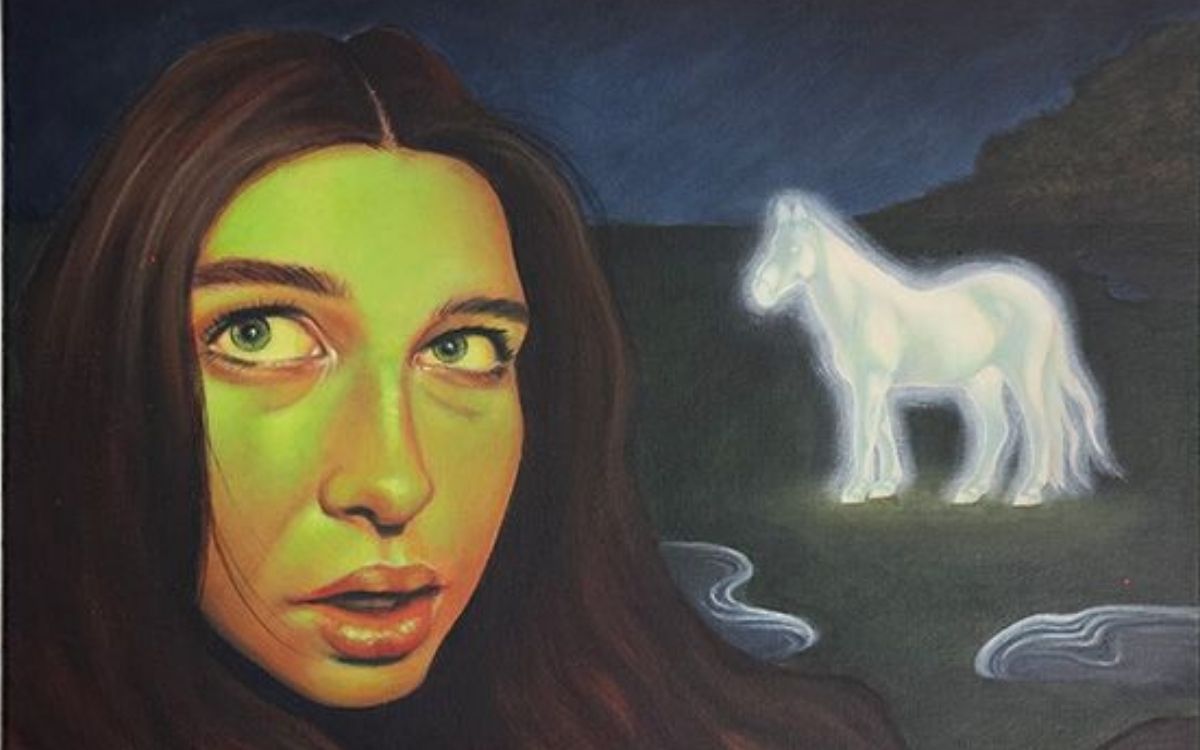
Art often emerges from the dialogue between inner experience and the visible world, and the work of Rebeka Grižon grows precisely from that intersection. Influenced by psychology, subconscious processes, and careful observation of human behavior, her artistic practice explores the hidden structures that shape perception and emotion. Painting becomes not only a form of expression but also a method of investigation, where color, symbolism, and layered imagery reveal internal tensions and invite viewers into a deeper reflection on the human psyche.
How has your upbringing shaped the themes and techniques you explore in your art today?
My main thematic focus is psychology and the subconscious, and that is not accidental. From a very young age, I was confronted with complex and difficult realities. On the surface, things may have appeared normal or stable, but underneath there was instability. I had to understand early on that the world is not always what it seems. That contrast between appearance and inner reality deeply shaped the way I see things. Because of what I experienced, I became very observant and realistic at a young age. I often felt different from my peers. I struggled to relate to what seemed important to them, because I was already thinking about heavier and more fundamental questions. That distance wasn’t something I chose, it was something that naturally formed because my perception had shifted. My world has never been black and white. It has always felt layered and intense.
Every situation carried multiple meanings at once. I learned to see complexity because I had to. It was a way of surviving, understanding emotional dynamics, reading tension, sensing what was happening beneath the surface. I needed answers. I was dealing with heavy themes, and I didn’t have the luxury of ignoring them. That is where my interest in psychology began. It wasn’t theoretical at first, it was practical. When everything around you feels unstable, the only thing you can work on is yourself. So I started doing that. Self-confrontation became necessary. That is why many of my paintings revolve around themes of facing oneself. My work explores instability beneath structure, the subconscious forces that shape our perception. I am not interested in illustrating trauma or specific events. I am interested in inner architecture, how unseen psychological layers construct what we believe is reality. My upbringing did not push me toward art as an escape. It pushed me toward art as investigation. Painting, for me, is a way of understanding what is not immediately visible. The need to understand, to look deeper rather than accept surface appearances, began early in my life. That need is still the foundation of my work today.
Can you pinpoint a single moment when you realized art was not just a passion but your purpose?
There was no dramatic revelation or single cinematic moment. It was gradual. Art was simply the one constant in my life, the one practice I kept returning to, regardless of circumstances. From childhood, I instinctively gravitated toward drawing, music, and visual storytelling. Even when my life was structured around other commitments, creativity remained non-negotiable. It was never just something I enjoyed. It was where I processed experience and understood myself. For a long time, art existed as a powerful passion. But about three years ago, something shifted. I made a conscious decision to choose creativity over comfort and over safer, more conventional paths. That was the real turning point. I stopped treating art as something dependent only on inspiration. I showed up daily, whether I felt motivated or not.
And through that consistency, something became very clear: painting was not something I did occasionally. It was something I needed in order to function fully and honestly. It became as essential as breathing. Through sustained practice, I also began to recognize how deeply art was shaping me. I was not only producing work, I was evolving through it. My themes, were not abstract interests. They were reflections of my own internal work. I noticed that through painting, I was confronting parts of myself, healing unresolved tensions, and developing greater self-awareness. Over time, I understood something fundamental. Art was not an escape from life. It was my way of engaging with life at its deepest level. It was the space where complexity, instability, beauty, and psychological tension could be explored honestly. That is when it shifted from passion to purpose.
How do you reconcile the tension between raw, innate creativity and the discipline required to master your craft?
For me, discipline was not natural, I had to built it deliberately. I used to wait for inspiration, which often led to inconsistency. The real growth began when I stopped romanticizing creativity and started structuring it. I committed to entering the studio daily, regardless of mood or productivity. At first, it felt mechanical. But over time, it became embodied. Now, the act of entering my studio triggers a mental shift. The body recognizes the space as a place of creation. Ideas surface more easily because I’ve trained myself to meet them consistently. Raw creativity is powerful, but without discipline it remains fragmented. Discipline does not suppress my inspiration, it just gives it structure. The balance between the two is what allows my work to evolve rather than remain impulsive.
Can you take us through the evolution of an artwork, from that first spark of inspiration to the finished piece?
Inspiration often arrives in a liminal mental state, particularly in the early morning, in the space between sleep and wakefulness. In that hypnagogic phase, imagery surfaces without force. It feels less constructed and more revealed. Other times, inspiration emerges from color relationships or textures observed in everyday life. A single tonal combination can trigger an entire visual narrative in my mind. When I begin a painting, I immediately eliminate the intimidation of the blank canvas by applying an underpainting. This initial layer is intuitive and expressive, it establishes atmosphere rather than detail.
From there, the process becomes meticulous. I work in many thin acrylic layers to create soft transitions that resemble the depth of oil painting. Because acrylic dries quickly, this requires patience and precision. The slowness is intentional. It allows the psychological narrative of the piece to unfold gradually. I do not assign a title at the beginning. The meaning clarifies as the painting develops. Often, what emerges is not what I consciously intended. The subconscious directs the final message. Only at the end do I articulate the conceptual framework in words. The process is both technical and introspective, craftsmanship and psychology evolving simultaneously.
How important is it for viewers to understand the intended message of your work? Does ambiguity add value or do you seek clarity in your expression?
I don’t require viewers to decode one specific message, but I do care about genuine engagement. My paintings operate on both personal and collective levels of the subconscious. Symbolism, color, and expression carry psychological weight. Some viewers respond intuitively, others analyze the work more intellectually. Both approaches are valid. In fact, I’ve noticed that people who don’t usually engage deeply with art, often react in the most direct way. I’ve asked them intentionally for their opinion because I was curious how they would see my work. Their responses are usually emotional before analytical, and that aligns closely with how the subconscious functions.
At the same time, context can deepen the experience. When a written reflection accompanies a painting, it may guide the viewer toward certain psychological layers. My work often explores themes shaped by early emotional formation, inner fragmentation, and transformation. Ideas strongly influenced by psychological theory, particularly Jung’s exploration of the unconscious.. But it is not mandatory. The work should be able to stand on its own. I value openness in interpretation. The paintings are layered and intentional. They invite multiple readings, yet they are not accidental. If someone chooses not to read the context, that is completely fine. The depth of interpretation ultimately depends on the viewer. My text can help someone go further, but it is equally possible to arrive there alone.
Can art be therapeutic? Have you ever experienced its healing powers personally, or seen it impact others?
Yes, I believe art can be profoundly therapeutic. When we create, the subconscious is always present as a silent director. We may consciously intend to communicate something specific, yet the work often resists. If a painting refuses to become what we planned, it is usually because something deeper is pushing in another direction. I believe this internal friction is often the source of what many artists call “art block.” It is not a lack of ideas, but a conflict between conscious intention and subconscious truth. In my own practice, I work intuitively. Because of this, I rarely experience creative paralysis. The process becomes a dialogue rather than an act of control. Painting, for me, reveals patterns, tensions, and internal structures that I was not fully aware of. In that sense, the process is diagnostic as much as expressive.
However, I do not approach art with the primary goal of healing. Healing is not the objective, it is a byproduct of confrontation. The act of creating requires time, attention, and commitment. To dedicate time to creation is to dedicate time to oneself. It is an act of self-respect. When we persist through difficulty and bring a work to completion, we reinforce our own capacity for endurance and focus. That alone strengthens self-awareness. The finished artwork then becomes something we can analyze. Over years of practice, one can trace personal evolution through recurring symbols, shifts in color, compositional changes, and thematic intensity. Art becomes a long-term psychological archive. Therapeutic impact is not limited to the creator. It can also occur in the viewer. There are moments, for example in music, when a singer articulates something you have felt but could never express. Suddenly, an internal experience gains language. The same can happen visually. A painting may move someone before they understand why. Upon reflection, they may recognize something previously unconscious within themselves.
In that sense, artwork can function as a mirror. It externalizes what might otherwise remain hidden for years. Sometimes a single image can accelerate a realization that would have required prolonged personal struggle to uncover. The nature of art is to go deeper, to shift perspective, to challenge perception, to destabilize habitual ways of seeing. Growth requires that shift. From personal experience, I can confirm that art has the capacity to reach very deep wounds. But it only becomes transformative if one is willing to look directly at what surfaces. Creation alone is not enough; confrontation and integration must follow. Art can open the door. Whether we walk through it is our responsibility.
How do you challange yourself to continualy grow as an artist while remainging true to your voice?
I challenge myself mainly through curiosity. I genuinely enjoy learning new things and understanding how different systems work, even if I might never directly need that knowledge. Painting is my main focus and priority, but I don’t believe growth happens if you stay inside only one medium or one way of thinking. Right now, digital 3D visual expression is my second strongest interest. What attracts me to 3D is the freedom, you can construct anything, any environment, any structure. Working in that space forces me to think differently. It sharpens my understanding of form, volume, light, and texture. When I was creating 3D work alongside painting on canvas, I noticed that my sense of structure became stronger. I started seeing shapes more clearly and understanding spatial relationships more consciously.
At the same time, my background in painting made learning 3D easier. I already understood composition, harmony, and balance. So the growth goes both ways. Each medium strengthens the other. What keeps me true to my voice, however, is not the medium. It’s the foundation behind it. My main intellectual interest has always been psychology. The subconscious, human behavior, internal conflict, these are not random themes for me. They are long-term fascinations. Because this interest is deeply personal and consistent, it acts as a filter. No matter what medium I experiment with, everything passes through that psychological lens. That is what prevents fragmentation.
I also consciously avoid creating work that is driven by trends or by the need to compete within the art world. When art becomes focused on being more shocking or more extreme than the next piece, it risks becoming empty. I am not interested in escalation for attention. I am interested in depth. For me, growth means becoming more precise, technically, conceptually, and psychologically. It means expanding my tools without abandoning my core questions. So the way I balance growth and authenticity is simple. I expand outward through new disciplines and knowledge. But I remain anchored inward through psychology. As long as that anchor stays intact, I can evolve without losing myself.
Artificial inteligence is increasingly infiltrating creative fields. Do you see artificial inteligence as a threat, a tool, or a collaborator in the art world?
I’ll be honest, the rapid evolution of AI does create a certain instability when I think about the future. It is undeniably a powerful tool, and it has the potential to be extremely useful. But I am concerned about how we choose to use it. We already live in a culture driven by instant gratification. Social media has trained us to seek fast dopamine hits, quick results, immediate output. AI fits very easily into that dynamic. It can generate images instantly, remove friction, and accelerate production. My concern is not only about jobs or professional competition, it is deeper than that. What worries me more is the possibility that people may lose patience for the process of creating. Creation requires time, frustration, repetition, doubt. It requires sitting with yourself. Through that process, we learn about ourselves and about others. Art builds culture. It connects people. If we remove the human struggle and replace it with instant output, what happens to that inner development? That is the part that unsettles me.
At the same time, I do not see AI as an enemy. It is a tool. But it does not possess lived experience. It does not have memory, emotional history, or embodied consciousness. My work is rooted in subconscious exploration, in psychological depth shaped by personal evolution. That dimension cannot be replicated by algorithmic pattern recognition. AI can simulate complexity, but it cannot replace interiority. So I don’t see AI purely as a threat or purely as a collaborator. I see it as a powerful instrument that reflects the intentions of those who use it. The real question is not what AI will do to art, but what we will allow it to replace and what we will insist on preserving.
How do you envision the evolution of your work in the coming years?
Technically, I aim to refine anatomical precision and increase efficiency without sacrificing detail. Perfectionism has slowed my process in the past, that is why learning to balance refinement with momentum is part of my growth. Conceptually, I am moving toward immersive environments that extend beyond canvas. I also work with 3D visual media and am increasingly interested in integrating painting, spatial design, and sound into cohesive experiences. My long-term vision is to create environments where viewers do not simply observe a painting but enter a constructed psychological space, one that encourages reflection and introspection on multiple sensory levels. As I evolve personally, the work will evolve with me. Psychology will remain foundational, but the medium may expand.
If you could communicate just one core message through your entire body of work, what would it be?
Confrontation leads to transformation. If there is one central thread running through my work, it is the idea that real change begins the moment we stop avoiding ourselves. My paintings encourage viewers to look inward, not superficially, but honestly. Many of our emotional patterns are rooted in early experiences and unconscious narratives that quietly shape our decisions. Avoidance can feel protective, even comfortable, but growth requires awareness. At the same time, I am not interested in glorifying pain. There is already enough aestheticization of despair. My intention is not to romanticize suffering, but to acknowledge discomfort while emphasizing the possibility of renewal. That is an important distinction.
This is also why I use vivid color palettes. The brightness is deliberate. It counterbalances psychological depth with the suggestion of resilience. Even when the work explores tension, fragmentation, or submerged emotion, it always contains the potential for emergence. There is always movement, never permanent collapse. For me, self-confrontation is not about staying in darkness. It is about creating the conditions for change. When we face ourselves honestly, we can begin to make real adjustments. At first, those changes may seem small. But over time, small internal shifts can completely reshape a life. If I could summarize the message simply, it would be this: self-examination is difficult, but it is liberating. It is never too late to redirect yourself. Nothing is so hopeless that growth is impossible. There is always the possibility of light.
Through her work, Rebeka Grižon approaches art as both exploration and mirror, creating images that encourage viewers to reflect on their own inner landscapes. Rather than offering fixed meanings, her paintings open space for interpretation, using psychological depth and symbolic elements to question perception and identity. As her practice continues to evolve through experimentation with materials and ideas, the central aim remains the same: to foster introspection and a deeper understanding of the self through art.