
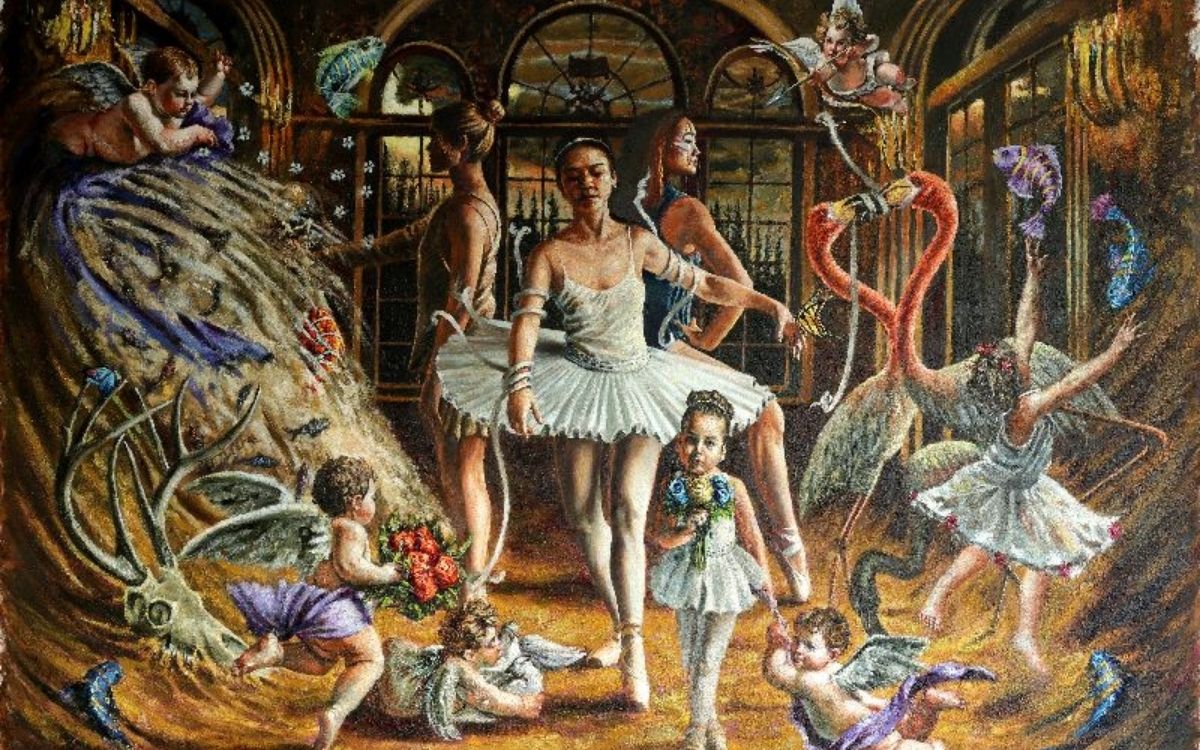
Mario Balsamo approaches painting not as an escape into freedom, but as a disciplined practice shaped by structure, consistency, and commitment. Rooted in an interior vision rather than external demands, the work develops through a methodical process that values clarity of thought, craftsmanship, and sustained attention. Refusing haste, trend-driven urgency, or performative authenticity, this practice treats painting as a space where ideas are allowed to mature slowly, guided by integrity rather than reaction. Art here emerges as a lifelong regime; one built on patience, rigor, and the quiet insistence of personal vision.
Art is often chosen as a medium for its freedom. Why do you personally turn to art, rather than another form of expression?
I believe there is a common misunderstanding when people associate art solely with freedom, because for me, the creative process often feels more like a rigorous discipline or a personal regime rather than a lack of rules. While many view freedom as being completely devoid of constraints, true art requires a specific line of consistency and a deep level of self-discipline to be executed properly. I did not necessarily choose art for its liberty, but rather because it is the only way for me to express myself through a structured commitment. For me, the freedom lies in the ability to express a vision, but the actual practice of painting is a demanding process that relies on order and dedication rather than total spontaneity.
How do you reignite creativity during those inevitable periods of self-doubt or stagnation?
In reality, I find it quite difficult to experience periods of stagnation because inspiration is constantly around me, and it often takes very little to reignite my creative drive. Sometimes simply looking at the work of another painter or reading a phrase somewhere is enough to spark a new idea, as the stimuli are continuous and ever present. My challenge is actually the opposite, as I often feel I do not have enough physical time to materially execute everything that passes through my mind. Whether I am opening a book, looking at images, or searching for contemporary painters online, the moment I see something that resonates with me, my inspiration is immediately reactivated and ready to be translated onto the canvas.
How does your art engage with or comment on pressing contemporary issues—social, political, or environmental?
I believe there are often misunderstandings regarding the role of an artist, who is first and foremost an individual with a deeply personal perspective that precedes any social obligation. In my practice, I do not feel a forced pressure to address contemporary issues, as my work is primarily an interior expression of my own mind and state of being rather than a tool for social problem-solving. While the final work may take on a political or social meaning through the eyes of the viewer, my starting point remains strictly personal and timeless. At the same time, this does not preclude the possibility of addressing specific issues in the future, yet I prefer to remain detached from instinctive or hurried reactions to global events. I choose to let my thoughts stagnate and decant, ensuring that if a message does emerge, it comes from a place of deep maturation rather than a fleeting impulse.
In a world flooded with imagery, what responsibility do artists have to stand out and say something authentic?
In a world that is continuously bombarded with images, I believe the only responsibility I have as an artist is toward myself and my own integrity. My primary duty is simply to remain true to myself, as the rest of the noise and the expectations of others do not concern my creative process. I do not feel that I must carry the weight of responsibilities for things that are external to my own identity, because being authentic starts with an honest commitment to one's own vision. By focusing entirely on this internal truth, the pressure to stand out in a specific way or to perform for an audience disappears, making the perceived problem of external responsibility non-existent in the end.
Can you take us through the evolution of an artwork, from that first spark of inspiration to the finished piece?
For me, the evolution of a painting is a clear and consistent process that has been refined through years of practice, and it can be essentially divided into four distinct phases. It begins with the initial thought where the idea is born, followed by a visualization phase where I imagine the finished work in its entirety within my mind. Once the mental image is clear, I move into the transformation stage, where I elaborate on that vision by gathering references, characters, and narratives to turn the thought into a concrete visual plan. Finally, the process concludes with the actual execution, which I view as the craftsmanship of the artist, where I materially transfer that refined image onto the canvas to create the final painting. This structured journey from the first spark to the tangible work allows me to maintain a precise focus on my creative intent while ensuring the technical quality of the result.
How has your artistic style transformed over the years? Are there specific influences, experiments, or moments that marked a turning point?
In reality, I have never worried about having a specific style, and for this reason, my work has not gone through distinct phases but has instead been a continuous and slow evolution. I believe that style is something that should emerge naturally through the consistency of daily work rather than being a goal to be pursued, as seeking a style can become a sort of cage that limits an artist and makes it difficult to escape. By not having a particular aesthetic as a fixed point of reference over the years, I have allowed my visual language to develop on its own without the constraints of a predetermined identity. To me, the most important thing is to keep working and let the hand and the mind find their path organically, ensuring that any stylistic signature is an authentic reflection of time and practice instead of a conscious or forced choice.
Can you share a moment when someone’s unexpected interpretation of your art gave you a new perspective?
I am consistently amazed and surprised by the diverse interpretations that viewers have when standing before my work, as their perspectives often reveal elements that I had never consciously considered myself. When people share what they see, I frequently feel like a mere instrument used to transcribe something, realizing that the true meaning of a piece is ultimately defined by the eyes of the observer. For this reason, I often decline to provide my own interpretation of my paintings, because an image is a deeply subjective experience that depends entirely on who is looking at it. We see this phenomenon every day with the images surrounding us in society and on social media, where a single visual can provoke a unique response in every person, and I find great wonder in discovering these hidden layers of my own work through the words and reactions of others.
Do you believe the ‘mad artist’ stereotype still holds weight, or is creativity more grounded than we think?
As I have mentioned previously, every individual is a world unto themselves, and this uniqueness applies to artists just as it does to any other human being. If there are artists whom society labels as mad or eccentric, it is simply because humanity is diverse, and some people naturally possess ways of expressing themselves that others might define as bizarre or unconventional. I do not believe there is a single, universal way to define a human being, and therefore there is no unique way to define an artist, as we are all people who fall within our own personal definitions of ourselves. For me, the stereotype of the mad artist is just one of many possible facets of human nature, but it cannot represent the whole, since every creator is a separate entity with their own balance and grounded reality.
How do you respond to debates about the accessibility of art? Should it be exclusive, or is it for everyone?
The question of accessibility is complex, because while art theoretically belongs to everyone once it leaves the studio and enters a museum or a church, we must also be realistic about the artist's need to survive. There is a persistent myth that an artist is a superhuman entity who lives on inspiration alone and does not need to pay rent or buy food, but the truth is that artists have always been paid for their work throughout history. In the past, art was often exclusive to those who could afford it, yet it became accessible to the public when the buyer decided to place it in a communal space like a cathedral. Therefore, the responsibility of accessibility does not belong to the artist but to society and the collectors, as my primary concern is to sustain my life through my craft. My art is for those who purchase it, and it is then up to the owner to decide if that work will eventually become a gift for everyone to enjoy, making the debate a social issue rather than a creative one.
What are five things you do to overcome creative blocks or feelings of discouragement?
Relaxing the mind, I believe that learning to truly relax is the first step toward clearing a mental path for new ideas to emerge.
Embracing imagination, I make a conscious effort to welcome my own imagination with open arms, allowing myself the freedom to dream without immediate judgment.
Seeking external inspiration, I look at the work of other artists across every possible art form, as observing different creative expressions often provides the spark I need to move forward.
Maintaining discipline, I continue to work even when I do not feel like it, because the act of showing up at the studio is often more important than the initial mood.
Forcing the process, I have learned that by forcing myself to physically paint regardless of my motivation, the creative flow eventually returns on its own through the very act of doing the work.
If you were appointed as President for a day, what initiative would you launch to support arts and culture?
If I held such power for a day, I would focus on a profound cultural shift rather than a simple law, as I believe the most effective way to support the arts would be to re-establish a modern form of patronage similar to what existed during the Renaissance. In that era, those who possessed wealth sought to elevate their social status by surrounding themselves with art and knowledge, turning their material success into a contribution to human culture. Today, the wealthy often prefer more immediate and superficial ways to demonstrate their status, focusing on things that strike the eyes rather than the mind, which is why I would use my influence to change how those with resources perceive their role in society. By instilling the idea that supporting creators is a necessary cultural duty, we would not only sustain the arts but also transform the very fabric of our social values, encouraging a world where prosperity is once again linked to the preservation of beauty and thought.
If you had only 24 hours left to create, how would you spend them?
I would spend those final hours painting while engaging in constant conversation, debate, and even the occasional argument with my wife, as this lively human connection is the true essence of my creative life.
What kind of legacy do you hope to leave in the art world?
As an artist and as a human being, I feel the innate need not only to express myself but to leave something behind for the future and while I may not yet know the specific nature of the legacy I will leave, I am certain that my work is driven by the fundamental desire to remain present through what I have created.
Across process, philosophy, and material execution, Mario Balsamo maintains a steady refusal of spectacle and imposed narratives. Painting remains a space for reflection rather than declaration, where meaning is shaped through time, labor, and restraint. Viewer interpretation is welcomed as part of the work’s life beyond the studio, yet the core remains anchored in internal coherence and discipline. What endures is a belief in art as presence—an act of continuity that resists noise, preserves intention, and leaves behind a trace of sustained human thought.