
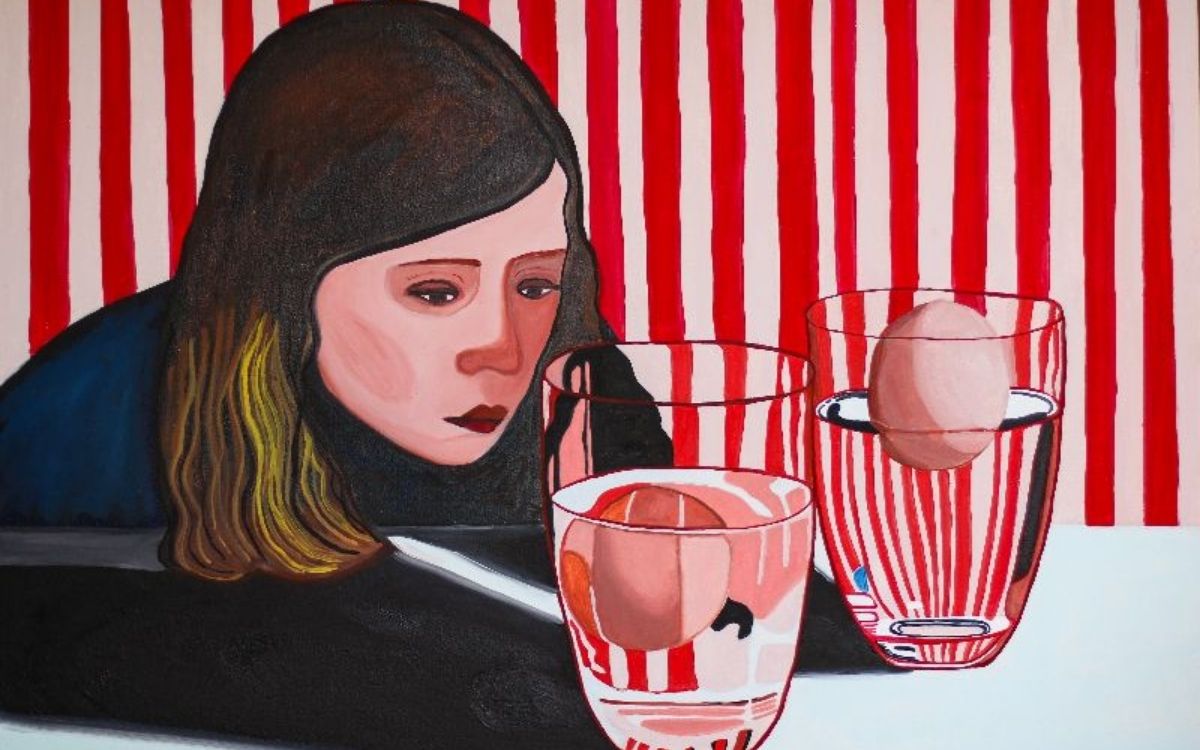
Raised on the outskirts of São Paulo and shaped by matrilineal care, Greta Coutinho develops a practice rooted in emotional residue rather than spectacle. Drawing from feminist theory, psychoanalysis, and lived experience, the work traces the quiet devastations embedded in devotion, care, and inherited expectations of femininity. Through painting, ceramics, embroidery, and printmaking, fragile materials become carriers of psychic weight, revealing how vulnerability, absence, and self-erasure unfold within everyday life. Rather than narrating trauma directly, this practice constructs atmospheres where emotional labor leaves visible marks—objects, gestures, and spaces that hold what is rarely named.
How has your upbringing or cultural heritage shaped the themes and techniques you explore in your art today?
Growing up in the outskirts of São Paulo, raised primarily by my grandmother, mother, and sisters, deeply shaped both my worldview and my artistic sensibility. From an early age, I witnessed how femininity was associated with sacrifice, emotional availability, obedience, and self-restraint — expectations that quietly structured women’s lives across generations. Art became my way of resisting these narrowing frameworks and of giving form to experiences that were often silenced.
This background directly informs my current research into the psychoanalytic concept of ravage — a slow emotional erosion produced through excessive devotion and painful relational dynamics. Rather than portraying overt violence, I am interested in the quiet devastations embedded in everyday life: abandonment, internal collapse, and the inherited patterns of female complicity. These themes emerge visually through domestic objects, empty dresses, fragile ceramics, and melancholic female presences, which function as emotional residues rather than literal narratives .
Coming from Brazil — a society deeply marked by gendered labor, affective expectations, and social inequality — also sharpened my awareness of how personal suffering intertwines with collective structures. My work is rooted in lived experience, but it seeks to touch something collective about vulnerability, intimacy, and emotional endurance.
If you could communicate just one core message through your entire body of work, what would it be?
At its core, my work speaks about the invisible emotional labor women carry — the slow, often unnoticed forms of self-erasure produced through love, care, and social expectation. I am interested in how devotion can become destructive when it demands the abandonment of one’s own subjectivity.
Rather than presenting explicit trauma, I focus on atmospheres of absence, fragility, and emotional residue. A pair of shoes left behind, a delicate glass, a suffocating or empty dress, or a ceramic vase on the verge of fracture all operate as metaphors for psychological states — traces of emotional surrender and internal collapse.
If there is a single message running through my practice, it is that devastation does not always scream; sometimes it unfolds quietly, beautifully, and socially rewarded. By visualizing these silent processes, I hope to create spaces for recognition, reflection, and emotional resonance.
Can you take us through the evolution of an artwork, from that first spark of inspiration to the finished piece?
My process begins not with a fixed image or outcome, but with prolonged research and material experimentation. I spend long periods reading psychoanalytic theory, reflecting on personal memory, observing everyday domestic spaces, and allowing certain emotional atmospheres to emerge before translating them visually.
Each medium plays a specific conceptual role. Ceramics and embroidery carry historical associations with femininity, domestic labor, fragility, and continuity across generations. Their susceptibility to fracture, wear, and imperfection mirrors psychic vulnerability. Monotype printmaking introduces stains, corrupted lines, and unpredictability — visual metaphors for emotional instability. Oil painting, traditionally dominated by male artists, becomes in my work a space for silent feminine presences, intimacy, and internal collapse .
I often let the materials guide the final form. Cracks in clay, blurred ink, or unfinished textures are not corrected but embraced as part of the emotional language of the piece. The artwork emerges slowly, through dialogue between concept, body, and material resistance.
How has your artistic style transformed over the years?
Initially, my practice was more centered on painting and illustration, especially through collaborations with literature and editorial projects. Over time, my research deepened conceptually and expanded materially, incorporating ceramics, embroidery, monotype, video, and installation-like elements.
This shift was driven by my growing engagement with psychoanalysis and feminist theory, as well as by an increasing desire to embody emotional states physically rather than only represent them pictorially. Objects, textures, fragility, and spatial presence became essential to how I think about psychological experience.
Participating in study groups, research collectives like FIGAS at UNESP, and interdisciplinary artistic environments helped push my work toward greater conceptual density and material risk-taking . Today, my practice is less about producing isolated images and more about constructing emotional ecosystems where different languages interact.
Do you feel that a personal connection to your subject matter is essential? How has this connection shaped your work?
Absolutely. My work is inseparable from lived experience — both my own and that of the women around me. However, I do not aim for autobiography in a literal sense. Instead, I see personal experience as a gateway into collective emotional structures.
The psychoanalytic notion that “I is another,” which resonates strongly in my thinking, reflects how individual subjectivity is shaped through relational and social dynamics. My experiences of femininity, devotion, vulnerability, and silence are not unique; they echo broader cultural patterns that many women recognise.
This personal connection gives emotional truth to the work, while research allows me to expand it beyond the individual into something socially and psychologically shared.
How do you challenge yourself to continually grow as an artist while remaining true to your voice?
Growth, for me, comes through discomfort and experimentation. I deliberately work with materials that resist control — clay that cracks, ink that bleeds, processes that demand patience and technical rigor. This unpredictability keeps the work alive and prevents it from becoming formulaic.
I also seek constant dialogue: through collective research groups, exhibitions, and interdisciplinary exchanges. Being exposed to other practices challenges my assumptions and pushes me to refine my conceptual framework.
At the same time, I remain anchored in my core research into emotional vulnerability, femininity, and psychic devastation. No matter how the materials evolve, this emotional and theoretical nucleus remains my compass.
How do you think art should be valued—emotionally, socially, or monetarily? Is there ever an objective measure? Is art created for the artist, the audience, or somewhere in between?
For me, impact is primarily emotional and relational rather than numerical. When viewers recognize something of their own experiences in the work — when they speak about memories, silences, grief, or emotional exhaustion — I feel the work has fulfilled its purpose.
Exhibitions, publications, and institutional recognition are important milestones in my career, but the most meaningful moments often happen in intimate conversations after a show, when someone feels seen by an object, a texture, or a quiet scene.
Art, in this sense, becomes a space of shared vulnerability rather than spectacle.
How do you envision the evolution of your work in the coming years?
Moving forward, I aim to deepen the dialogue between painting, sculpture, and spatial installation, exploring how emotional states can occupy physical environments rather than remain confined to individual objects.
I am particularly interested in ritualistic and symbolic gestures — such as ceramic vases conceived as offerings in dialogue with painted female figures inspired by the Ophelia motif, for example — functioning as fragile monuments to emotional surrender and mourning.
Living and working internationally has also expanded my perspective on how emotional structures transcend cultural borders while manifesting differently across societies. My future work will continue exploring this intersection between the intimate and the collective, vulnerability and social construction.
Across painting, sculpture, and spatial assemblage, Greta Coutinho builds an artistic language where fragility resists erasure and silence becomes form. Emotional collapse, devotion, and endurance emerge not as spectacle but as lingering presence—cracks in clay, abandoned garments, stains that refuse correction. As the practice expands toward installation and ritualized gestures, intimacy and collective experience remain tightly interwoven. What persists is a commitment to making visible the slow, socially rewarded devastations that shape inner lives, offering spaces where recognition replaces explanation and emotional truth takes precedence over resolution.