
What do you do with grief that has nowhere formal to go, for a flooded field, a drowned animal, a landscape that no longer looks the way you remember it?
North Evoia has been living with that question since the 2023 floods swept through the region's rivers and farmland, and it's one that doesn't resolve on its own timeline. There's no municipal form for grieving an olive grove, no line item in a recovery budget for the fact that a place doesn't feel the way it used to.
The second round of the Local Urban Lab in Evoia picked up that question directly. Local Urban Labs are the part of Turning the Tide where research stops being abstract, artists move into a place for weeks at a time, rather than visiting for an afternoon, so what they make comes out of actual contact with the people and the land rather than a brief written from a distance. Two artists, Angela Liosi and Maria Gouveli, spent that time in the region running workshops, visiting flood-affected sites, and talking with residents about what had changed and what hadn't.
Picking Up Where Round I Left Off
The round opened with a digital meeting between artists from both phases, where Giorgos Gerontides and Christina Maridaki shared what they'd learned in Round I with Angela and Maria before the new residency began, which sites had already been visited, which conversations were still open, what had shifted in the months since. It wasn't a formal handover so much as a working conversation, the kind meant to keep momentum and context moving between one group of artists and the next rather than starting each round from zero.
The workshop series that followed was led by Dr Spyros Bofylatos, focused on sustainability and climate resilience. Angela and Maria used the sessions to work through questions of ecological grief and community healing, testing early ideas against feedback from people who'd actually lived through the floods, and figuring out how their own practices might respond to what Evoia had been through without flattening it into a simple recovery story.
Angela Liosi — Water Walk
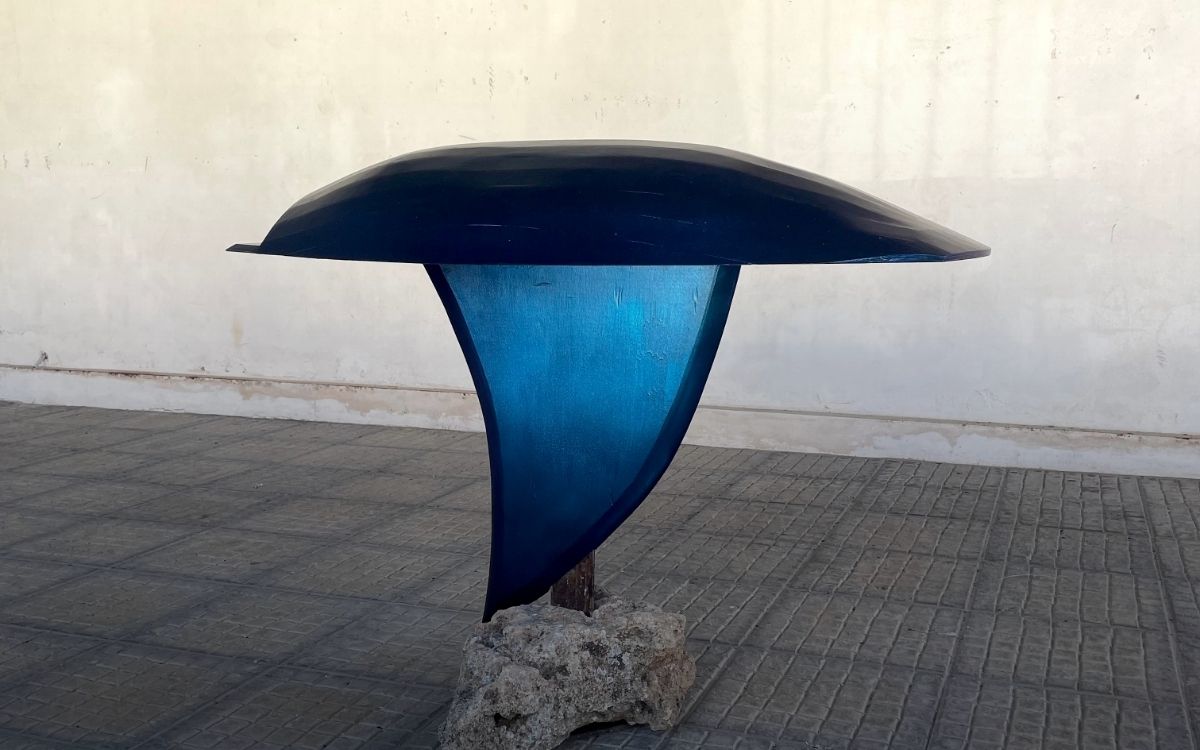
Water Walk is a sculptural installation built around the animals, domestic and wild, that died in the North Evoia floods. Its ark-like form is amphibious, built to suggest movement through both land and water, and deliberately made from features of multiple species rather than one, so no single animal stands in for all the others that were lost.
It isn't an ark of rescue. Angela built it as an ark of mourning, a direct response to the line so often repeated after disasters — "at least no human life was lost" — that quietly writes off every other kind of loss as beside the point. It's a sentence meant as comfort that ends up doing the opposite for anyone who lost a flock, a herd, or a family dog to the water. Water Walk refuses that hierarchy, giving physical weight and a fixed place to lives that usually go uncounted in the official record of a disaster. The installation will stay on view in Mela's building in Limni until 2027.
Maria Gouveli — Nexus Project
Nexus Project takes a different route into the same territory. Built around the Lelantine Plain, a stretch of land with its own long history of flooding and renewal, farmed and re-farmed for generations despite the risk, it's a multi-layered, interactive map that tracks emotion and memory alongside geography.
The map doesn't follow straight lines or fixed borders; it branches the way rivers and floods actually move, spreading out from a handful of anchor points rather than sitting inside a grid. It's built from Maria's own conversations and time spent in the region, the stories people told her about specific fields, specific trees, specific years the water came too high, drawing on dynamicist theory and eco-feminist thinking to blur the line between research and artwork. What it maps, in the end, isn't just terrain, it's the web of connection between people, land, water, and memory that holds a place together, long after the water itself has receded.
Neither piece resolves what happened in North Evoia, and neither tries to. What they do is make space for a kind of loss that usually goes unrecorded: the animals, the land, the version of a place that existed before the water came through and put it somewhere people can actually stand in front of it, together, without needing to explain why it still matters.
This work is part of Turning the Tide, co-funded by the European Union under the Creative Europe programme, running artist residencies and community-based research across coastal cities affected by climate change. You can explore Maria's and Angela's work in full on the project website.
