
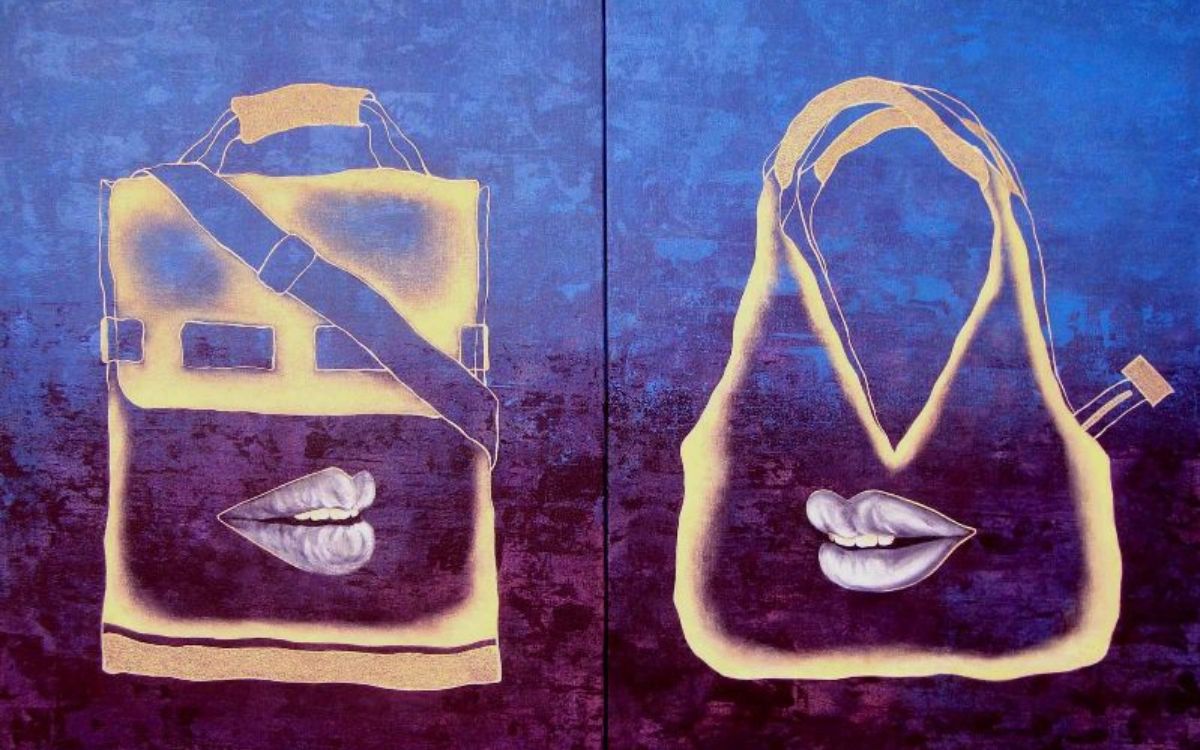
In Puja Sarkar’s world, the everyday is not overlooked—it is exalted. Drawing from a childhood marked by discipline, solitude, and the intimacy of silence, Sarkar transforms mundane objects like safety pins, handbags, combs, and lipstick into charged vessels of memory, emotion, and resistance. Her vibrant mixed-media works are not merely personal—they are deeply political, feminist, and spiritual, offering viewers an encounter with the invisible weight of social norms, emotional trauma, and forgotten rituals.
How has your upbringing or cultural heritage shaped the themes and techniques you explore in your art today?
My upbringing and cultural heritage have profoundly shaped the themes and techniques in my art. My strict and disciplined childhood, marked by restrictions and loneliness, led me to form deep connections with everyday objects. These objects—like bags, combs, and umbrellas—became companions, transforming into symbols of intimacy and emotional expression in my work. These objects embody untold stories and feelings, reflecting your personal journey. Therefore, as life demanded in its natural course, those inanimate objects converted into animated things to me with all their feelings and passion just like living beings. Loneliness and Emotional Attachment to Objects is Autobiographical Narratives and reflects a universal human experience, resonating across cultures. As a woman artist from India, my work explores feminine objects (lipstick, footwear, etc.) with symbolic depth, addressing themes of identity, empowerment, and societal expectations. My cultural context as an Indian woman informs my feminist narratives, Feminist Perspective and Feminine Identity. Growing up in a constrained environment influenced my focus on femininity and women’s empowerment. Objects like safety pins or footwear become metaphors for societal norms, while hybrid forms or body parts subtly critique gender roles and intimacy.
My solitude transformed into a "strong positive energy," driving me to explore themes of detachment, emotional attachment, and the surreal. The bizarre, playful depictions, loneliness as Creative Fuel in my work mask deeper traumas or oppressive memories. My art subtly critiques materialism, oppression, and social issues blending personal trauma with broader societal concerns or social commentary. The use of bright colors and playful forms disguises darker themes, a juxtaposition that may stem from cultural norms where indirect expression is often safer. My hybrid forms and surreal imagery draw from both personal imagination and cultural storytelling traditions, where Surrealism, symbolism and metaphor are central to conveying layered meanings. My strict upbringing sensitized me to societal issues which I address symbolically. My reliance on objects as metaphors stems from childhood imaginings. The surreal, childlike forms are deliberate contrasts to their deeper, often unsettling meanings.
My experimentation with Mixed Media and Unconventional Materials like waste materials and mixed media reflects resourcefulness tied to cultural practices of reuse and innovation. It also challenges traditional art forms, mirroring my journey beyond rigid childhood boundaries. That ties back to my intimacy with objects, transforming their "functionality" into artistic rebellion. The energetic hues and textural surfaces in my work echo the vividness of Indian visual culture—from folk art to urban pop aesthetics—while serving as metaphors for emotional intensity. My work reflects a rebellion against the monotony of my disciplined past, while textures add emotional depth. The fragmented, collage-like compositions mirror the complexity of my experiences, blending personal memory with collective cultural narratives.
My art is a dialogue between personal history and cultural heritage. The loneliness and discipline of my upbringing forged a unique visual language where objects become storytellers, while my Indian identity and feminist perspective infuse my work with universal yet culturally rooted themes. My art is a cathartic reimagining of childhood loneliness, where restrictive walls became a canvas for feminist surrealism. By giving voice to inanimate objects, I turn personal silence into universal resonance—a testament to how upbringing shapes artistic identity. Techniques like surreal symbolism and mixed media bridge tradition and contemporary experimentation, making your art both intimate and globally resonant. This encapsulates how my past and cultural contexts are not just influences but active collaborators in your creative process.
Does spirituality or a connection to something larger than yourself influence your creative process?
Absolutely; though not in a traditional or religious sense at all. My spirituality is rooted in the unseen connections between objects, emotions, and the collective human experience. When I paint, I feel like a conduit for something larger: the silent stories of inanimate things, the unspoken struggles of women, or the raw energy of color and form.
Loneliness taught me to listen deeply—not to gods or doctrines, but to the whispers of everyday objects. A safety pin isn’t just metal; it’s a symbol of fragility and resilience. A pair of shoes carries the weight of journeys taken and withheld. In this way, my work becomes a ritual of transformation. I take the mundane and elevate it into a visual language that transcends my individual self.
There’s also a meditative quality to my process. When I lose myself in layers of texture or the rhythm of brushstrokes, time dissolves. It’s in those moments that I feel most connected—not to a divine presence, but to the universal pulse of creativity itself. My paintings are my prayers: chaotic, colorful, and deeply personal, yet meant to resonate with anyone who has ever felt confined, silenced, or longing to break free. So yes, spirituality fuels me—but it’s the spirituality of a woman who finds the sacred in safety pins and the infinite in an umbrella’s curve.
My studio is my temple, but the deities I worship wear unlikely forms—a cracked mobile phone, a pair of broken spectacles, a lipstick smeared across a canvas like a bloodstain. This isn’t mysticism; it’s the alchemy of attention. When I spend hours rendering the stitches on a handbag or the gleam of a bangle, I’m not just painting objects—I’m performing a kind of consecration.
Animism of the Ordinary - the way a comb nestles in hair or an umbrella unfurls against rain—these are my sacred texts. Growing up, these objects were my silent confidants. Now, they become vessels carrying the weight of collective memory. In ‘The Umbrella’, the curve of the handle isn’t just a line—it’s the spine of every woman who’s ever used an umbrella to shield herself from more than rain.
Ritual is like a process by mixing acrylics with crushed petals or rusted nails isn’t merely technique; it’s an offering. The act of layering—gesso like a burial shroud, pigment like rebirth—mirrors the cycles I see in life. When I stitch buttons onto a canvas, each puncture feels like a mantra. My pure consciousness transforms into Collective Unconscious through my Art. I don’t believe in superstitions, but I believe in the journey of Divine Experiences. The way viewers sometimes freeze before my creation, their breath catching—that’s the moment my personal symbols become universal. The red in painting (Composition in Red) isn’t my anger alone; it’s the flush of a thousand stifled voices.
My surrender is my freedom - There are nights when the brush moves without me. The shapes that emerge—a safety pin morphing into a fetus, a high heel cracking like an egg—these aren’t fully my doing. It’s as if the objects themselves demand to speak. That’s my spirituality: a pact between my hands and the unseen currents that twist through women’s lives, through history, through the quiet violence of the everyday.
My each and every art is a journey of my Unfinished Prayer. Every artwork is a question, not an answer. When I embed shards of mirror into ‘Gossip’, forcing viewers to see their own reflections amid the painted chatter—that’s my version of communion. No sermons just shattered light.
"To create is to whisper to the universe and wait for the echo." My spirituality lives in that pause between the whisper and the echo. It’s not about divinity; it’s about daring to believe that a painted lips or an eyeglass from my old collection can hold galaxies of meaning. And when someone stands before my work and feels own stories stir? That’s the miracle. Would you call this faith? I call it the relentless act of seeing.
How does your art engage with or comment on pressing contemporary issues—social, political, or environmental?
My art deeply engages with contemporary social issues, especially those surrounding gender, identity, emotional trauma, and the silent struggles of everyday life—particularly from a woman’s perspective.
Rather than making direct political statements, I choose to express these concerns through symbolic objects and surreal narratives. . I don’t shout; I embed. Feminine items like lipsticks, combs, handbags, and umbrellas—seemingly trivial—become metaphors for emotional endurance, social expectations, and the invisible labor and identity of women. The mundane tools of femininity—combs, safety pins, lipsticks—are recast as symbols of resilience and rebellion. A broken bangle isn’t just debris; it’s a fractured expectation. A handbag spilling its contents mirrors the invisible labor women carry. Hybrid forms (like footwear fused with organic matter) critique the co-modification of female bodies, while bright colors disguise the weight of these narratives in playful surrealism. These objects are not ornamental; they carry the weight of untold stories, cultural conditioning, and suppressed desire.
My thoughts that depict the Environmental Anxiety are expressed through discarded materials—synthetic flowers, plastic fragments, rusted metal—find new life in my mixed-media works. These aren’t aesthetic choices; they’re archaeological layers of human excess. Textures mimic ecological decay: cracked surfaces resemble parched earth, while glossy acrylics mirror the seductive sheen of consumer waste.
An outcome of present society is Urban Isolation which is I experienced as Loneliness, my oldest companion, and I transform it into a language of connection. Objects become surrogates for human presence—a single umbrella stands in for collective shelter, a pair of shoes holds the ghost of a journey. I lure viewers with vibrant colors and whimsical forms, only to reveal darker truths upon closer inspection. A glittering surface might conceal a safety pin’s sharp edge; a playful composition might unravel into a commentary on surveillance.
For instance, in works like “He and She” and “Gossip”, I explore themes of gender dynamics, intimacy, and the complexity of human relationships. The visual tension in these works speaks to the emotional imbalance and power play often present in society. In “Composition in Red”, the bold use of color and texture reflects inner agitation—personal, but also collective. It echoes the psychological impact of social injustice, greed, and systemic pressure.
My creative process is shaped by personal experience, but it resonates with wider feminist and social consciousness. I reflect on cruelty, insecurity, social stigma, emotional trauma, and mental health, particularly through a woman’s lens. As an artist and social activist as well, I am constantly interacting with realities that are difficult to articulate in words—my paintings become the medium for that conversation. Through this symbolic language, I am not just to critique but to awaken—a viewer’s emotional and moral sensitivity to the often invisible dimensions of contemporary life.
Why It Matters? Art shouldn’t preach—it should haunt. By using the familiar to interrogate the systemic, I invite viewers to question their own complicities. The objects in my work are both witnesses and accomplices, silent yet screaming.
What unusual or unexpected sources of inspiration have deeply influenced your work?
My deepest inspirations have come from places most would overlook—silence, loneliness, and the intimacy of mundane, everyday objects.
Growing up in a world defined by strict boundaries and emotional quietness, I developed an unusually intense connection with the inanimate. Lipsticks, combs, handbags, safety pins, even a pair of worn-out shoes—these were not simply accessories, but silent witnesses to my life. These objects carried memory, comfort, tension, and identity. Over time, they became my companions, my metaphors, and eventually, my language.
Another unexpected source of inspiration is the emotional energy stored within discarded materials. I often use synthetic flowers, rusted metal, bus tickets or plastic fragments—not for visual effect, but because they carry traces of human excess, neglect, and history. These materials speak of environmental decay, consumerism, and the ephemeral nature of beauty. What is thrown away becomes a relic in my world, infused with new meaning and sacredness.
Dreams, subconscious imagery, and internal emotional landscapes also play a vital role in shaping my visual vocabulary. Many of my hybrid forms are born unconsciously—childlike, surreal, and strangely familiar. They emerge from a place where memory, myth, and personal history converge.
Lastly, loneliness itself has been a powerful and unusual teacher. Rather than being something to escape, I’ve embraced it as a generative force—transforming emotional isolation into visual intimacy. In my work, a single umbrella may stand for protection, a lipstick for voice, a bangle for broken expectation. These objects do not just represent—they feel. My inspiration doesn’t come from grandeur or spectacle, but from the quiet poetry of ordinary life, from the things people pass by without noticing. That’s where I find truth—and from there, I build my universe.
Describe a piece you’ve created that has held the most emotional weight for you. What makes it significant?
One of the most emotionally charged pieces I’ve created is “He and She.” On the surface, it might appear playful or surreal, but beneath that visual language lays a deeply personal exploration of gender dynamics, intimacy, and emotional imbalance.
This work came from a space of internal conflict—a place where love, longing, and power intersected in painful and revealing ways. The male and female forms in the painting aren’t simply characters—they are emotional energies, often in tension, searching for understanding, caught in an unspoken conversation. I didn’t paint them to represent any specific individuals, but rather to embody the emotional complexity of relationships—their fragility, imbalance, silence, and desire.
What makes “He and She” significant is that it reflects a turning point in my practice—where I began to speak more boldly, yet symbolically, about emotional pain and gender politics. Through vibrant colors and surreal form, I concealed what was too raw to express directly. That contrast—the beauty of the surface hiding the turbulence beneath—mirrored my own emotional reality at the time.
Creating it was almost like exhaling something I had held in for years. Every brushstroke felt like release, every object in the composition felt like a sentence I had been waiting to say. It’s a painting that still speaks back to me—and perhaps that’s why it holds so much weight.
Do you feel a personal connection to your subject matter is essential? How has this connection shaped your work?
A profound, almost visceral connection to my subject matter is not just essential—it is the very foundation of my practice. My art emerges from an intimate dialogue between my lived experiences and the objects that have witnessed them. This relationship transforms personal narratives into universal truths, making each piece both deeply autobiographical and expansively relatable.
Personal Connection is my Creative Oxygen- My work would not exist without the emotional weight I carry for my subjects—everyday objects like safety pins, umbrellas, bags or broken bangles. These are not arbitrary choices; they are relics of my life. A comb is not just a tool but a keeper of childhood solitude. A handbag spills its contents as a metaphor for the invisible burdens women shoulder. This connection is sacred: it allows me to embed layers of meaning into the mundane, turning a lipstick into a manifesto or a pair of shoes into a ghostly pilgrimage.
I transformed Loneliness to a Universal Language- My strict, isolated upbringing taught me to find companionship in objects. This loneliness, once a wound, now fuels my art. When I paint, I am not merely depicting an umbrella—I am channeling the collective memory of every woman who has used one as a shield against more than rain. The personal becomes political; the solitary becomes shared. My connection to these subjects is alchemical—it transforms private pain into a visual language that resonates across cultures and experiences.
My process is a spiritual practice, though not in a traditional sense- It is a ritual of attention, where rendering the stitches of a bag or the curve of a bangle becomes an act of consecration. The hours spent layering textures gesso like skin, pigment like breathe—are meditative. I surrender control, allowing objects to "speak" through me. A safety pin might morph into a fetus; a high heel might crack open to reveal soil. This is not whimsy—it is the result of a deep, almost mystical bond with my materials, where creativity becomes a conduit for something larger than me.
The choice of objects is my cultivation of Emotional Archaeology- Discarded materials—rusted metal, synthetic flowers, torn paper—are not aesthetic choices but emotional artifacts. I collect them as an archaeologist would, sense the stories they carry. By embedding these fragments into my work, I resurrect their hidden narratives, forcing viewers to confront the humanity in what society discards.
There lies a risk of vulnerability- This connection demands courage. To infuse a piece with raw emotion—as in ‘He and She’, where gender dynamics are laid bare through surreal forms—is to risk exposure. But it is also where the magic happens: when personal truth transcends into collective catharsis. The vibrancy of my colors and the playfulness of my compositions are deliberate disguises, disarming viewers before revealing deeper truths about power, loss, or resilience. Art divorced from personal truth is decoration. My connection to my subjects is what gives the work its heartbeat. It allows me to "paint with the debris of the world to rebuild what’s been broken"—not just for me, but for anyone who has ever felt silenced, overlooked, or trapped by societal expectations.
Can art be truly therapeutic? Have you experienced its healing power personally, or seen it impact others?
Art isn’t just therapeutic—it’s survival. I know this because my practice has been both scalpel and salve, dissecting wounds while stitching them shut with pigment and texture.
The canvas has been my silent therapist for decades. When words failed—locked away by childhood discipline and loneliness—I poured my anguish into safety pins that doubled as sutures, umbrellas that sheltered more than rain. Creating He and She was particularly cathartic; the painting’s vibrant tension masked my own unspoken battles with gender dynamics. Each brushstroke exorcised emotions I couldn’t name.
Those very objects society dismisses as trivial—broken bangles, safety pins—became my tools for emotional archaeology. By embedding them in artworks, I performed an exorcism of sorts. A crushed bus ticket in a collage wasn’t just paper; it carried the weight of my isolation during daily commutes. The act of transforming it into art neutralized its power to hurt.
There’s science beneath the magic: the rhythmic act of brushwork regulates breath, the focus required to layer colors quiets mental chaos. But for me, it’s more primal. Kneading gesso into canvas mimics the physicality of grief; stitching buttons onto a surface becomes a meditation on repair. My mixed-media works literally embody healing—rusty nails and turmeric stains are my version of a pharmacist’s ingredients.
Therapy requires honesty, and art demands the same. Some days, the studio feels like an operating theater—I leave raw and exhausted. But always lighter. A student once told me, "Your painting Composition in Red gave me permission to be angry." That’s the paradox: by channeling my pain into something beautiful, I’d accidentally built a bridge for others to cross.
Art therapy isn’t about pretty pictures. It’s the courageous act of externalizing the unspeakable so it can be faced, held, and—when ready—released. My work proves that even the most personal pain, when transformed through creativity, becomes universal medicine.
Artificial Intelligence is increasingly infiltrating creative fields. Do you see artificial intelligence as a threat, a tool, or a collaborator in the art world?
As an artist who transforms personal trauma and mundane objects into resonant visual narratives, I view AI not as a threat, but as a complex new pigment in our collective palette—one that requires mindful application. Here’s how I reconcile this technology with my deeply human creative practice:
There is a Limit of Synthetic Emotion- AI cannot replicate the lived experience that fuels my work—the childhood loneliness that makes my brush tremble, or the feminist rage that stains my canvases red. My art’s power comes from its embodied truth Technology lacks the visceral connection to materiality that defines mixed-media art.
AI can act as a Curatorial Partner, Not Creator- Where I see potential is in AI’s ability to reflect rather than generate—like using machine learning to analyze how viewers emotionally engage with my Composition in Red series or Pink Series. It could help decode the universal in the personal, showing how a safety pin’s symbolism resonates across cultures. But the soul of the work must always remain human.
Guarding against Theft of Trauma- My art is born from vulnerability—He and She emerged from years of silenced gender struggles. The danger lies in AI scraping such intimate visual languages without context or consent. We must resist the flattening of personal symbolism into generic "styles" for algorithms to mimic.
A Call for Ethical Collaboration- I envision AI as a Studio Assistant:
Tool: Enhancing technical processes (color matching textures to any realistic objects)
Mirror: Revealing unconscious patterns in my decades of work
Never a Replacement: The alchemy of transforming pain into art requires a human hand to hold the safety pin, to stir the rust into paint
Like the discarded materials I resurrect, AI is raw matter—devoid of meaning until an artist imbues it with purpose. My practice has always been about reclaiming power from what’s been cast aside; we must approach AI with the same intentionality.
Name five pivotal lessons you’ve learned that shaped your artistic journey.
Loneliness Can Be a Creative Catalyst
My childhood isolation taught me to find companionship in the mundane—safety pins, combs, and umbrellas became my silent confidants. This emotional alchemy transformed solitude into a wellspring of artistic vision, where objects carry the weight of untold stories. "Loneliness, my oldest companion, became my most honest collaborator."
The Ordinary Holds Extraordinary Power
An old bag or a broken bangle is not debris—it’s a relic of human experience. By elevating these overlooked fragments into art, I’ve learned that truth often hides in plain sight. My work insists that what society discards, art can resurrect.
Vulnerability Is a Form of Strength
Creating He and She taught me that art thrives on raw honesty. Masking painful themes with vibrant colors and surreal forms doesn’t dilute their power; it invites viewers into deeper dialogue. "I dress wounds in glitter so others might recognize their own."
Feminism Lives in the Details
A lipstick tube is never just a lipstick tube—it’s a manifesto on beauty standards, autonomy, and silent labor. My practice has shown me that systemic oppression can be interrogated through intimate, everyday symbols. "The personal is political, and the political is embedded in objects."
Art Must Bridge the Personal and Universal
Technique alone is meaningless without emotional resonance. Whether using turmeric stains or rusted nails, I’ve learned that materials must feel as much as they signify. My artist statement—"I paint with the debris of the world to rebuild what’s been broken"—captures this lesson: art heals only when it speaks both to my journey and to yours.
These lessons are not just steps in my evolution—they’re compass points for any artist seeking to transform pain into purpose, and the ordinary into the extraordinary.
If you could live anywhere in the world to further inspire your creativity, where would it be?
For me, place has never been about postcard landscapes or exotic locales—it's about the alchemy of who surrounds me and what fragments of life I can gather there. Geography is neither a barrier nor an inspiration in itself. I could live anywhere in the world, even in the midst of breathtaking nature, but such surroundings would only truly inspire my creativity if shared with a kindred spirit—a good soul beside me to share and cherish these experiences. If I were to choose a home to fuel my creativity, it would need three elements, distilled from decades of making art from loneliness and connection:
I crave neither mountains nor beaches, but unremarkable corners where everyday artifacts whisper stories. My ideal place would be rich in discarded humanity—the raw materials I consecrate into art.
As I've learned through works like ‘He and She’ and ‘Composition in Red’, my art thrives when there's one soul who understands the sacredness of my process—not necessarily another artist, but someone who sees the world as I do:
Who knows a safety pin can be a suture or a weapon
Who reads the wrinkles in a BUS ticket as Braille for urban loneliness
Who recognizes that turmeric stains on my fingers aren't mess, but memory
This person would transform any location into fertile ground for creation, making even the most mundane environment vibrate with creative potential. My art has always been about intimacy with the unseen—whether objects or emotions. As I wrote in my statement: "My loneliness inspires my works through the objects I use every day as a woman." A "good soul" beside me wouldn't dilute that solitude; they'd help me translate it into universal resonance. The location itself matters only as a vessel for these human connections and found objects.
"Home isn't a place on a map—it's where someone understands why I keep a drawer full of broken bangles, and adds their own treasures to the collection."
What kind of legacy do you hope to leave in the art world?
My artistic journey began with the ignored objects of daily life - safety pins, broken bangles, discarded metro tickets - each carrying untold stories. From my art collage’s days, I faced numerous hurdles in gaining acceptance for my work precisely because of these unconventional subjects. Many questioned why I insisted on elevating the mundane into art. Yet I remained true to my vision because I understood the profound reason behind using these objects - they were my most authentic mode of expression, the language through which my deepest truths could emerge. Numerous rejections and failures couldn’t break my true self.
This struggle has shaped the legacy I hope to leave:
A Testament to Artistic Authenticity
I want my body of work to stand as living proof that staying true to one's creative vision - no matter how unconventional - ultimately triumphs. Those early challenges taught me that real art isn't about pleasing others, but about fearlessly expressing what burns within you. My story says to future artists: "Create from your core, even if the world doesn't immediately understand."
A Feminist Language of Objects
Safety pins, lipsticks, bags, shoes and broken bangles might forever after be seen as carriers of women's histories—not just functional items, but vessels of resistance, memory, and quiet rebellion. I want my work to have permanently altered how society views the mundane tools of femininity.
A Blueprint for Alchemizing Pain
A methodology proving that personal trauma—loneliness, restriction, gendered violence—can be transmuted into universal art. Like the turmeric/color stains and rusted nails in my work, I hope to leave behind proof that even life's corrosion can become pigment for beauty.
An Archive of Urban Emotionality
My collections of bus tickets, discarded packaging, and faded fabrics form an alternative historical record—one that values the emotional residue of everyday life as much as grand events. Future artists might continue this "archaeology of the ordinary."
Permission to Create With Whatever Remains
My radical use of waste materials and unconventional media should stand as testament: great art requires no expensive tools, just the courage to assign meaning. A future artist working with plastic bags or cracked phone screens might cite my practice as precedent.
The Message at the Core - More than any particular technique or style, I want my legacy to carry this essential truth: Stay faithful to your inner voice despite all negativity. The world may resist unconventional expressions at first, but true art emerges when we courageously honor what speaks to our soul. My journey from uncountable rejection to recognition proves that authenticity ultimately finds its audience.
As I wrote in my statement: "My artworks dissolve topographic barriers... my personal visual statement gains universal appeal." The truest legacy would be a world that continues this work—where marginalized voices feel empowered to transform their discarded realities into art without sanitization.
"May the world remember me not just for the art I made, but for the objects they can no longer ignore after seeing it for the conviction that ordinary objects - and ordinary people - as vessels of extraordinary stories. The rejections and failures that marked my journey became my ultimate motivators - silent cheerleaders pushing me toward mastery. It is this hard-won triumph that I hope will inspire others in the most profound way."
For Puja Sarkar, painting is not a depiction but a consecration. Every object—a lipstick, a safety pin, a worn-out shoe—carries the aftertaste of memory, silence, and resistance. Loneliness becomes pigment, discarded materials become scripture, and the mundane is transfigured into mythology. Through surreal forms and symbolic matter, the forgotten speaks, the fragile endures, and the personal becomes a shared archive.