
What happens when the artists who know a disaster firsthand and the artists arriving from outside it are put in the same room?
For the third round of the Evoia Local Urban Lab, that wasn't a rhetorical question; it was the design.
Most residencies keep local and international artists on separate tracks: locals contribute context, visitors contribute a fresh eye, and the two rarely overlap in the actual working process. This round did something different. It merged the Local Urban Lab with the International Lab in Evoia, putting local and international artists in the same rooms, the same village visits, the same conversations.
The result was a two-way exchange. International artists got to read the landscape and its climate realities through people who'd lived it, its history, its communities, what the fires actually took. Local artists picked up different methods and a different set of questions from their international counterparts. The focus throughout was the layered aftermath of the 2021 wildfires and subsequent floods in Northern Evoia, not just the disaster itself, but how it tangled together political negligence, economic opportunism, administrative failure, and gaps in climate knowledge.
Learning the Landscape
Artists traveled to villages across the affected region, including the point where the 2021 wildfires first broke out. Walking scarred ground and talking with the communities living on it gave a sense of scale that statistics don't carry on their own. Visits to local museums added another layer, the long relationship between these communities and the forests that shaped their identity across generations.
A series of webinars with Marilena Gidarakou, an atmospheric physicist, added the scientific grounding underneath the personal stories: how these particular fires and floods actually formed, and why. The goal wasn't to turn artists into scientists, but to make sure the work that followed was accountable to both the facts and the lived experience.
Íchni: Memories of the Future
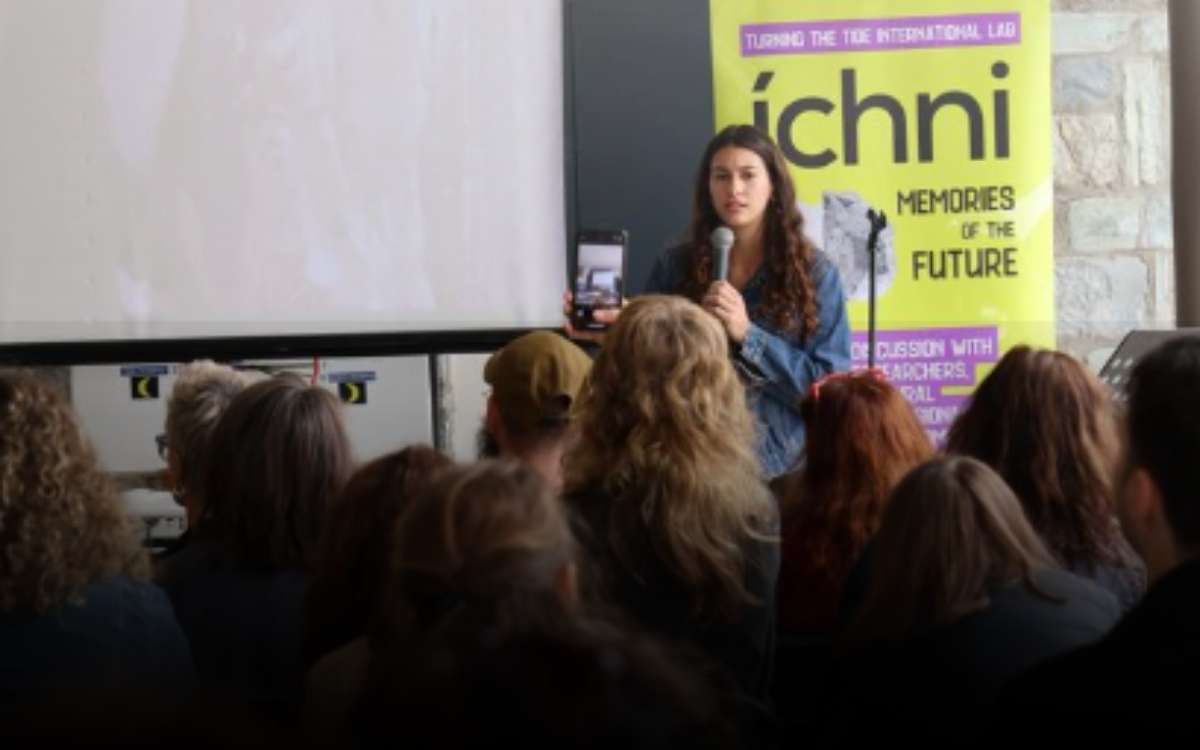
The round closed with a public exhibition, "Íchni: Memories of the Future," showing work by local artists Froso Papadimitriou and Eleni Vrettakou alongside international participants over three days. The final exhibition took place at Tetartokyklion, overlooking the Euripus Strait, home to a genuinely strange tidal phenomenon where the water reverses direction several times a day. That constant reversal became an apt backdrop for an exhibition about transformation, instability, and the work of adapting to forces nobody fully controls. Entry was free, open to residents of Chalcis and the wider Evoia region.
Froso Papadimitriou — The Golden Pine Cone and Co-existence
Froso Papadimitriou built two connected works from months spent in the villages of Kourkouloi, Kexries, and Skepasti. "The Golden Pine Cone" (2025), in watercolor, fine line pigment ink, and digital prototype, takes the form of a fairy tale assembled from testimonies gathered on those visits. The fairy tale format isn't an escape from the material; it's a way of making the tangle of causes behind the disaster legible: negligence, opportunism, administrative failure, and a basic lack of climate knowledge, all compounding into catastrophe.
"Co-existence" (2025) was made with children from the same villages, using thread and acrylic on canvas, drawing on the ancient myth of the three fates. White thread on white canvas — nearly invisible at first, stands in for how easily people forget their place in a shared ecosystem. As the children add color, the connections become visible again, a small, literal argument for what attention and participation can restore.
Eleni Vrettakou — Un/Making Ground
Eleni Vrettakou's "Un/Making Ground" (2025) is a multimedia installation built from what Evoia's floods and fires left behind, charred pine trees whose roots once held riverbanks in place, and silted mud still settling inside buildings long after the water receded. The work treats erosion as both subject and method: burnt surfaces are sanded down slowly, their dust kept and archived, while clay sediment gets reshaped into forms that recall thresholds, sills, fragments of interrupted domestic life.
Rather than fighting the decay, the work leans into it. The sculptures stay unfinished, left open to touch, weather, and time. Working with material this unstable raises a real question: "What does it mean to build something with care once you've given up on permanence"?
Round III made a case for collapsing a boundary that residencies usually keep intact; local versus international, art versus science. What Froso and Eleni built, shaped in part by that collaboration, holds the complexity of what happened in Northern Evoia without flattening it into a single story. Evoia's recovery isn't a resolved narrative; it's still being written by the people living through it, one testimony and one reshaped fragment of clay at a time.
Don’t forget to explore Froso’s and Eleni’s works in detail. Stay tuned; there’s so much more to come!
This work is part of the Turning the Tide project, co-funded by the European Union under the Creative Europe programme, supporting artistic research into climate justice and resilience in waterfront communities across Europe.
