
Is a young artist with an intellectual disability being welcomed into the room, or just being allowed to stand in it?
Across Europe, young people with intellectual disabilities often face barriers to fully participating in the arts, not just as audience members, but as creators, collaborators, and professionals. Through our project Artistic Minds, co-funded by the European Union, we are working to change that.
We recently hosted a three-day study visit in Athens, Greece (June 3–5, 2025), bringing together partners from across Europe to explore how the Cultural and Creative Sectors (CCS) can become more inclusive, accessible, and sustainable. The visit focused on two things: building stronger cross-border collaboration and identifying the real gaps that prevent young artists with intellectual disabilities from engaging meaningfully in cultural life.
The Reality Nobody Wants to Discuss
Here's what happens in most European cultural spaces when young people with intellectual disabilities want to participate: they get offered "special programs" that keep them safely separated from the "real" artistic work. They become recipients of cultural activities rather than creators of cultural value. Meanwhile, the arts community pats itself on the back for being inclusive while maintaining systems that ensure these young artists never actually compete for resources, recognition, or professional opportunities.
We've seen this pattern across every country we work in. Talented young people with intellectual disabilities get channeled into therapeutic art programs instead of professional development pathways. They're invited to showcase events where their work is celebrated for being "inspiring" rather than evaluated for its artistic merit. The message, however well-intentioned, is clear: your participation is welcome, but your ambition isn't.
This segregation doesn't just limit individual artists; it impoverishes European cultural life. When we exclude perspectives, experiences, and creative approaches from people with intellectual disabilities, we're not just being unfair. We're making European arts less innovative, less representative, and frankly, less interesting than they could be.
A Discovery That Changes the Conversation
Through our research, we learned something that challenges how most cultural organizations think about inclusion: the barriers young people with intellectual disabilities face aren't primarily about their capabilities, they're about how cultural systems are designed. The problem isn't that these young artists can't participate. The problem is that participation pathways assume everyone learns, creates, and communicates in identical ways.
The breakthrough happens when cultural spaces stop trying to make artists with intellectual disabilities fit existing systems and start adapting systems to accommodate different ways of being creative. This isn't about lowering standards. It's about recognizing that artistic excellence comes in forms we haven't been trained to see.
A Look Inside the Study Visit in Athens
Over three intensive days, the group took part in a structured programme blending artistic workshops, peer learning, and visits to local initiatives. The team at MARGARITA introduced a traditional hand-printing technique used by artists with intellectual disabilities. During the visit to KMOP's Day Centre, young people from KMOP and Anoixti Agkalia presented an interactive music-theatre performance.
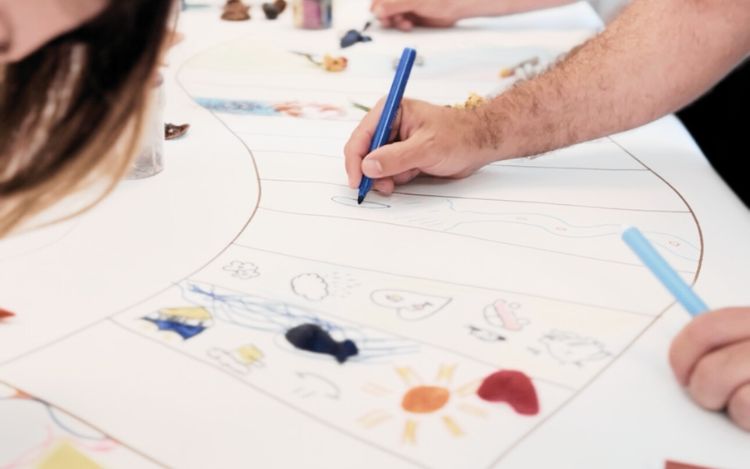
What stood out was the blurring of lines between performers and audience: despite language differences, everyone became part of the experience, singing, dancing, and co-creating together. The programme also included a collaborative workshop in which young people and visiting participants co-created a visual "life path," using drawing and symbolism to share personal stories and hopes. Each session closed with open dialogue and reflection circles focused on inclusive methods, co-creation, and accessibility in cultural practice.
Through these shared activities, the study visit offered practical insight into how local communities in Athens are using art to build access, belonging, and cross-cultural connection. Each day ended with a facilitated reflection circle, giving participants space to process their experiences and discuss inclusive pedagogies, ethics in participation, and how to carry these insights back into their own work. Throughout, our aim was to encourage honest, grounded conversation about what inclusion really looks like, not as an ideal, but as a set of choices made every day by practitioners, artists, and communities.
The European Network We're Building
What emerged from Athens wasn't just a successful study visit; it was proof that cross-border collaboration can accelerate inclusion in ways that isolated national efforts cannot. When artists with intellectual disabilities from different European countries work together, something powerful happens. They discover that creativity transcends not just disability labels, but also language barriers, cultural differences, and national boundaries.
These partnerships represent more than resource sharing. They're creating a European network of practitioners who understand that true inclusion requires systemic change, not just good intentions. These aren't feel-good initiatives. They're strategic efforts to transform how European cultural sectors recognize, develop, and support artistic talent regardless of intellectual differences.
This network approach matters because individual organizations often lack the resources, expertise, or institutional power to challenge exclusionary practices on their own. But when cultural organizations across six European countries coordinate their efforts, share what's working, and co-develop new methodologies, that's when real transformation becomes possible.
Over the coming months, partners will continue to explore how arts and culture can become more accessible and inclusive, adapting approaches to local contexts while building on shared principles.
This study visit was carried out under the Artistic Minds Project (101173645), co-funded by the Creative Europe Programme of the European Union, supporting inclusive participation in the arts for young people with intellectual disabilities.
If you're working on something similar, or have reflections, examples, or tools worth sharing, get in touch; this is a conversation still unfolding.